

One headline says rhinoplasty is a leading facial operation. Another says nose reshaping declined. If you are researching a natural rhinoplasty, those stories can sound like competing verdicts on whether surgery is a good idea. They are better understood as answers to different questions. A procedure can remain common among specialist surgeons while its estimated annual volume falls in a broader report. Neither finding tells you what your nose needs, whether an operation is appropriate or who should perform it.
Explore this article
- Read the anatomy before choosing a look
- Why smaller, narrower and more defined are different goals
- Skin is part of the result, not just a covering
- A photograph can change the apparent problem
- A worked example: a better brief than 'make it natural'
- What should remain clear after the consultation
- The two numbers are not competing votes
- Ask four questions of any trend claim
- Turn popularity into a better portfolio test
- A consultation should end with a decision, not a trend
- Use the data without joining a race
Read the anatomy before choosing a look
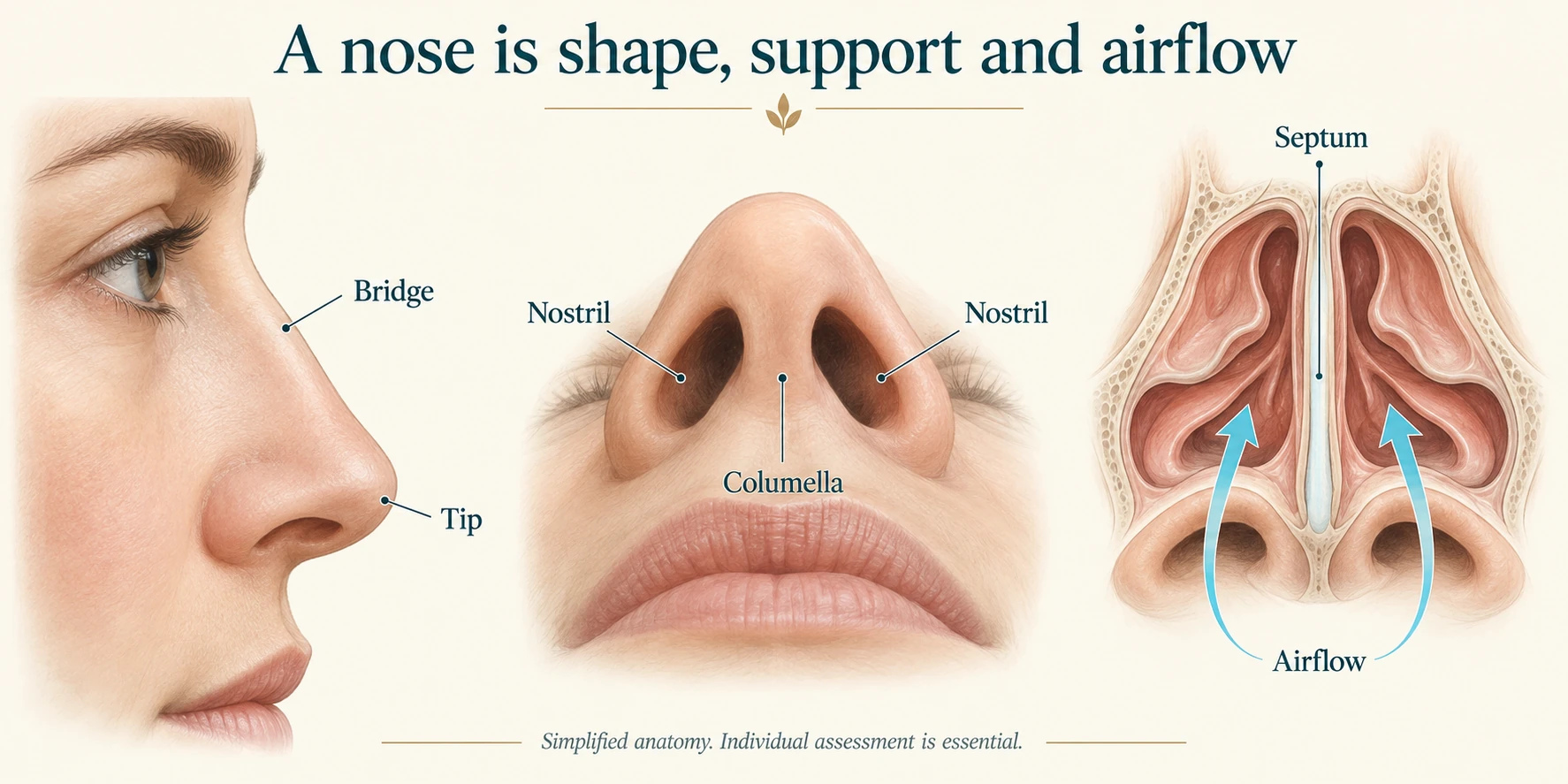
The visible nose has several jobs at once. The bridge creates the upper profile, the tip contributes projection and orientation, and the nostril margins frame the base. Inside, the septum separates the passages. These are connected structures, so a request to change one visible feature deserves a discussion of the rest. The accompanying diagram gives you a vocabulary for that conversation; it is not a map for diagnosing your own nose. ASPS' rhinoplasty overview describes the range of appearance and structural breathing concerns that can be assessed.
Start by pointing to the feature that bothers you and describing the situation in which you notice it. 'My bridge dominates my profile' is more informative than 'I need a smaller nose.' 'I like my nose from the front but dislike the tip in a side photograph' identifies a possible conflict worth exploring. A useful consultation turns that observation into an examination, then explains what a change could affect in other views. You should understand the connection before agreeing to a list of procedures.
Why smaller, narrower and more defined are different goals
These words are often used interchangeably, but they describe different visual requests. A lower bridge changes the profile; a narrower-looking front view concerns width; more visible tip definition concerns how shape shows through the covering tissues. Asking for all three without ranking them can create a brief that is difficult to interpret. A surgeon may agree with one request, limit another and recommend preserving a third feature. That deserves an explanation, not an assumption that the most extensive change must be the best.
Rhinoplasty may involve reshaping bone or cartilage and, when needed, adding cartilage support. It is not simply a subtraction operation. ASPS describes both removal and grafting as possible parts of nasal reshaping. That is why 'make it smaller' does not tell you the surgical work or its functional implications. Procedure overview. For your own decision, compare the proposed change with the structure the surgeon intends to preserve or support. Ask to see that reasoning from the front, profile and base rather than accepting a profile-only discussion.
Skin is part of the result, not just a covering
The underlying framework and the overlying skin and soft tissue contribute to what you see. A 2026 review specifically discusses their interaction in rhinoplasty planning. Skin and soft-tissue review. An attractive digital outline does not establish how your own tissues will reveal that outline after surgery. Ask the surgeon what your skin means for visible definition, possible irregularities and the limits of the change being discussed.
This is useful when reference photographs show a sharply defined nose on someone with a different face or skin characteristics. Instead of asking whether the surgeon can reproduce that nose, ask which part of the reference expresses your preference: a smoother bridge, less tip prominence, or a particular relationship between the tip and upper lip. You can communicate taste without converting another person's anatomy into a promised endpoint. The more precisely you describe the preference, the easier it is to discuss what is reasonable and what may be a poor fit.
A photograph can change the apparent problem
A 2018 mathematical-model study reported that a photograph taken from 12 inches could increase the perceived nasal breadth relative to facial width by about 29–30%, compared with an orthographic projection. At five feet, the modeled effect was essentially absent. The study modeled perspective using average facial measurements; it was not a trial of surgery and it does not establish the distortion in every individual's phone photograph. The selfie-effect research.
The practical insight is that a close photograph can emphasize the forward-projecting nose differently from the rest of the face. Compare several ordinary views before building a surgical brief around one upsetting selfie. Keep distance, angle, expression and lighting in mind when reviewing a gallery too. The image may be accurately recorded by the camera while still being a poor representation of the relationships you see in person. That distinction does not dismiss your concern; it improves the evidence used to explain it.
For a gallery comparison, look for similar framing and expression in the starting and follow-up photographs. Check whether the view includes the entire face and whether other procedures were performed. If the caption does not provide timing, ask. Make a note of what is documented and what you are merely assuming. A gallery is most useful when it helps you ask about a relevant case, not when it encourages you to measure yourself against a single idealized photograph.
A worked example: a better brief than 'make it natural'
Consider a hypothetical person who dislikes a bridge bump but values a recognizable family profile and also reports one-sided blockage. The starting brief might contain three separate lines: 'Change the prominence of the bridge,' 'Preserve the overall character of my face,' and 'Assess the breathing symptom.' Those lines are connected, but none should disappear simply because the most eye-catching photograph concerns the bridge. The consultation should clarify which problem the examination supports, what the proposed work would address and what falls outside it.
Now compare two explanations. 'We will give you a smaller, prettier nose' offers little you can evaluate. 'This is the feature we can change, this is the structure we plan to preserve, this is the functional assessment, and this is the uncertainty' gives you something to discuss. The second explanation may include limits you did not expect. That does not automatically make it inferior; a meaningful limit can reveal that the surgeon has understood your preservation goal. Use this example to organize a consultation, not as a recommendation for a particular operation.
What should remain clear after the consultation
You should be able to describe the proposed change, the features to preserve, the separate breathing assessment and the principal risks in your own words. You should also know what follow-up is planned and how results will be assessed over time. Mayo Clinic describes rhinoplasty planning as taking account of the person's other facial features, nasal skin and desired changes. Patient information.
If a simulation is used, treat it as a way to discuss direction and priorities. Ask which aspects it illustrates and which it cannot predict. Do not make an image file the sole definition of success. Write a short summary after the visit, including questions you still cannot answer. That summary makes a second consultation more useful because you can compare clinical reasoning rather than trying to remember two sets of flattering descriptions.
The two numbers are not competing votes
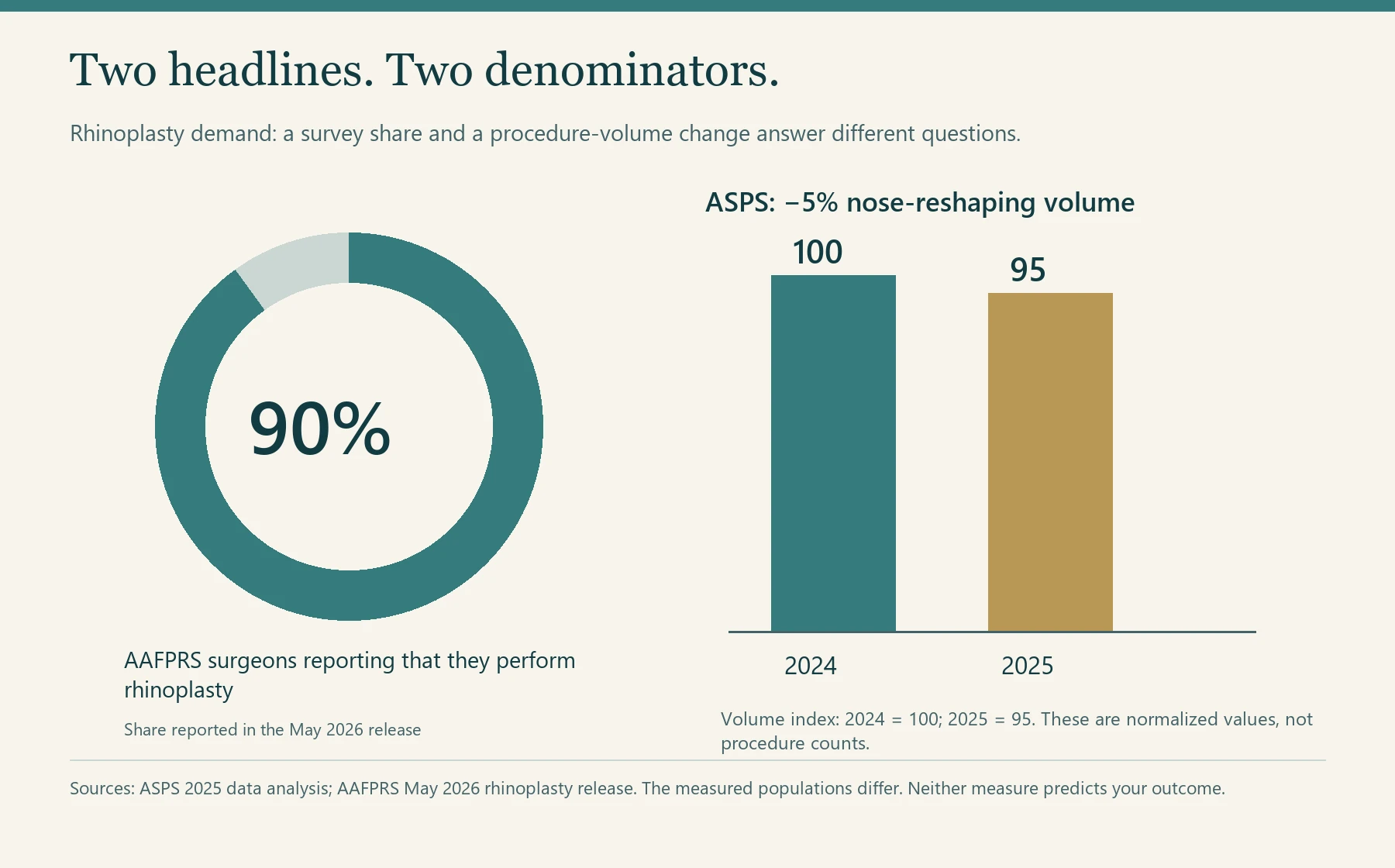
The American Society of Plastic Surgeons' discussion of its 2025 data reports a 5% decline in nose reshaping. Separately, the AAFPRS' May 2026 rhinoplasty release says 90% of its facial plastic surgeons report performing rhinoplasty. The first is a year-over-year change in procedure volume; the second describes the share of surveyed surgeons performing the procedure. A surgeon may perform rhinoplasty routinely even if the number of operations in a reported population changes. Put the measurement beside the number before deciding what a headline means. ASPS 2025 analysis. AAFPRS rhinoplasty release.
Ask four questions of any trend claim
What was counted: procedures, surgeons, consultations or online searches? Who was included: a professional society's respondents, an estimated national population or one clinic? What period was measured: a calendar year, a survey date or a publication date? Finally, what comparison was used? A change from the prior year is different from a share of all procedures. This small audit protects you from mistaking a marketing headline for clinical evidence. It also makes conversations more useful: instead of asking whether a procedure is fashionable, you can ask why a particular operation would address your concern.
Turn popularity into a better portfolio test
The useful gallery question is not how many impressive results are on the website. It is whether the published cases help you understand a relevant starting point, the treatment described and the timing of the result. Ask to compare several cases, consistent angles and mature follow-up where available. A single profile view can conceal issues that matter from the front or underneath. Breathing goals also require their own assessment; an attractive image does not establish an airway outcome. When looking at a case, separate what the caption actually documents from what you are inferring from the photograph.
A consultation should end with a decision, not a trend
Prepare a short brief: your main concern, the features you would like to preserve, any breathing symptoms, previous procedures and the practical limits of recovery. Then ask what the surgeon sees, which options are reasonable and what would remain uncertain after surgery. Request the reasoning behind the recommendation and the alternative of doing less, waiting or declining surgery. If two consultations produce different plans, compare their assumptions about the problem before comparing prices or technique names. That is evidence you can use; national procedure popularity is context, not a prescription.
Use the data without joining a race
High demand does not make a procedure suitable, and a decline does not make it obsolete. Trends can reflect many factors that a single headline cannot disentangle. Avoid using them to create urgency around your own booking. A decision about natural rhinoplasty deserves enough time to understand your goals, verify the surgeon's credentials and evaluate the plan. For readers researching rhinoplasty in Los Angeles, the useful next step is a consultation that relates those questions to an examination—not an attempt to choose the most fashionable nose or operation.
A practical comparison worksheet
| Headline measure | What it can tell you | What it cannot tell you |
|---|---|---|
| Annual procedure-volume change | Direction within the report's measured population | Your suitability or likely outcome |
| Surgeons reporting a procedure | How widely respondents perform it | How many operations each surgeon performed |
| A published gallery case | Documented treatment and visible appearance at that point | Your diagnosis or a guaranteed result |
| Your consultation | An individualized assessment and proposed options | Certainty about every aspect of healing |
Questions patients ask
Do fewer rhinoplasties mean the operation is becoming less effective?
Procedure volume is not an effectiveness measure. To assess an operation, ask about evidence, case selection, relevant risks and the outcome measures that matter to you.
Should I choose a surgeon because rhinoplasty is most of their practice?
Relevant experience is useful, but it belongs alongside verified qualifications, appropriate cases, surgical reasoning, safety arrangements and communication. Ask what experience is relevant to your particular concern.
Can a natural rhinoplasty be planned from a photograph?
Photographs can help explain priorities. They cannot replace examination of anatomy, skin, support and function or establish a precise predicted result.
Can a close selfie make my nose look wider?
Yes, perspective can change its apparent proportions. A 2018 model found approximately 29–30% greater perceived nasal breadth at 12 inches relative to an orthographic reference. It is a modeling result, not a measurement of every selfie. Compare consistent photographs and an in-person assessment before using a close image to define a surgical change.
Does a cartilage graft always mean a larger-looking nose?
No. The reason for a graft may concern support or contour rather than a goal of increasing overall size. Its visible effect depends on the assessed anatomy and the specific plan. Ask the surgeon to distinguish the structural purpose from the appearance change being proposed.
Your next step
Explore the practice's rhinoplasty information and published cases, then request a consultation with your preservation and change priorities.
Sources and further reading
- ASPS: 2025 plastic surgery by the numbers
- AAFPRS: The Natural Nose Era, May 2026
- ASPS: Rhinoplasty consultation questions
- ASPS: Rhinoplasty overview
- ASPS: Rhinoplasty procedure
- Skin and Soft Tissue Management in Primary Rhinoplasty, 2026
- Mayo Clinic: Rhinoplasty
- Ward et al., 2018: Nasal Distortion in Short-Distance Photographs
Educational information. An examination and an individualized discussion with an appropriately qualified surgeon are needed to assess options, risks and recovery.
Posted on behalf of Sedgh Plastic Surgery