

A revision rhinoplasty second opinion should not have to begin with a detective story told from memory. A photograph shows appearance at one moment; it does not explain the operation, the graft material, the course of healing or what changed after an earlier treatment. A compact evidence folder can make the appointment more useful without turning you into your own diagnostician. Its purpose is to help the clinician understand the history, identify missing information and examine the concern you have now.
Explore this article
- Why the operative report is more useful than the procedure nickname
- Four terms you may encounter—and the questions they create
- Build a photo sequence that can answer a question
- A breathing timeline deserves its own line
- What if you cannot obtain the original records?
- A first-page summary that a clinician can actually read
- What a useful second opinion should add
- 1. The operative report—and a clear list of dates
- 2. Graft, implant and injection information
- 3. Dated photographs, not a camera roll
- 4. A symptom timeline with breathing kept separate
- 5. Treatments and 6. follow-up documents
- 7. Your goals: what to change, preserve and understand
Why the operative report is more useful than the procedure nickname
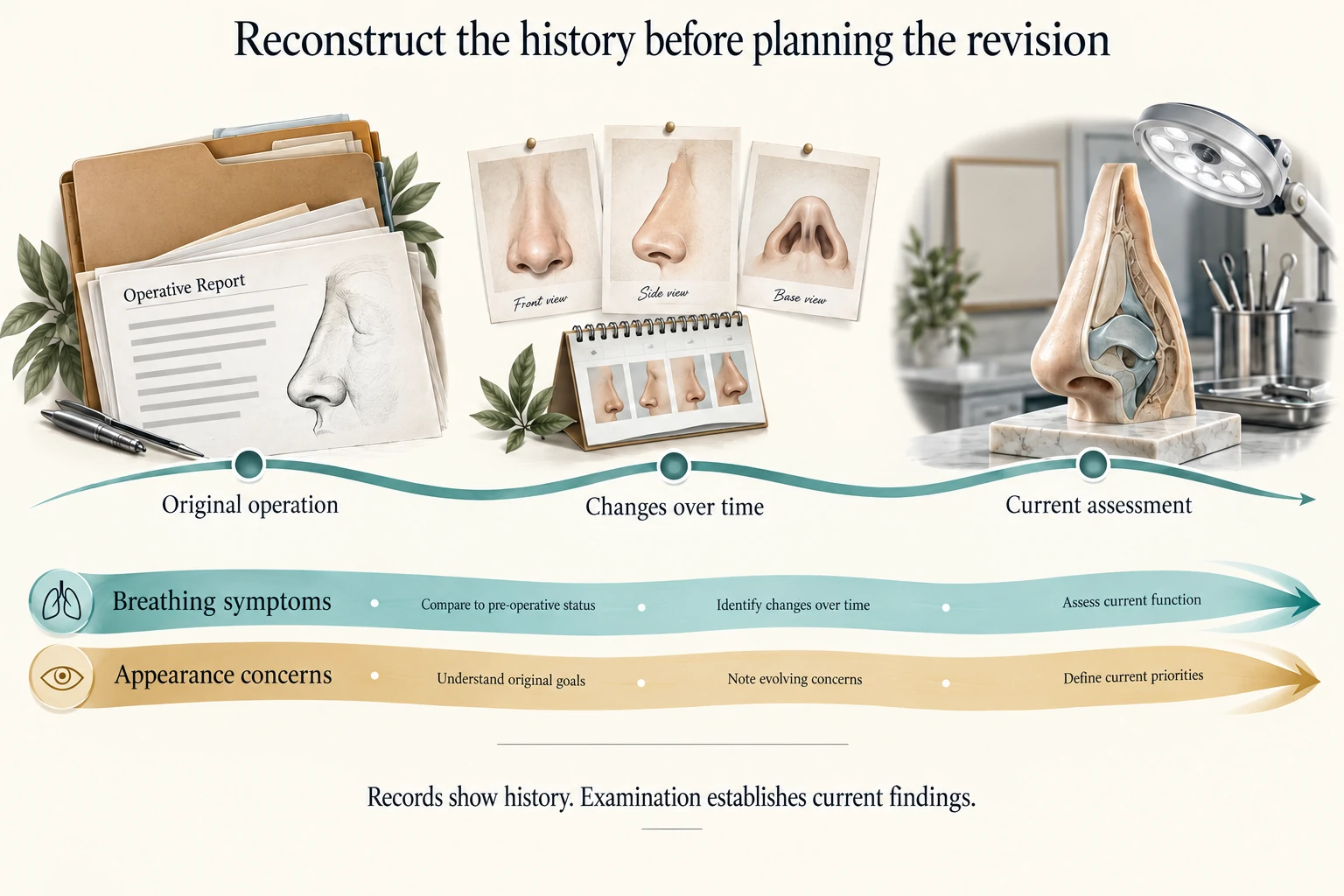
A booking confirmation may say 'rhinoplasty' without documenting what was done. An operative report may describe access, reshaping, grafts and other work. Those details can help a second surgeon understand the starting information available for assessment. A report is not a perfect reconstruction of every tissue change, and the examination remains essential, but it is much more informative than trying to remember a conversation from several years earlier.
Read the report to collect questions, not to assign blame or diagnose yourself. If you see an unfamiliar term, copy it into your summary and ask what it means in the context of that operation. Do not assume that a named maneuver caused a current concern merely because both appear in the same story. The useful relationship is between documented history, current findings and possible explanations. A second opinion should make clear which part is established and which remains an inference.
Four terms you may encounter—and the questions they create
'Osteotomy' refers to a bone-cutting maneuver. 'Septal cartilage' identifies cartilage from the partition between the nasal passages. A 'graft' is material used for a particular structural or contour purpose. 'Columella' refers to the tissue between the nostrils. These words can orient you to a report without teaching you how to perform or assess a surgical maneuver. ASPS' procedure explanation describes nasal reshaping and potential cartilage sources. Patient procedure overview.
For any term, use the same follow-up: Where was the work performed? What was its intended purpose? Is its present condition known from the report or does it require examination? The final question is especially important. A document can establish that a graft was placed, but it cannot by itself establish how that graft relates to today's appearance or symptoms. Bring the original wording rather than substituting an internet interpretation that may omit an important detail.
Build a photo sequence that can answer a question
A useful sequence separates before surgery, early recovery and later appearance, with a date attached to each image. The purpose is to show what changed and when, not to create a dramatic before-and-after montage. If you have comparable front, profile and base views, keep them together. Avoid filters or retouching; if an image was altered or its date is uncertain, say so. A candid image can still help provide history, but it should not be presented as a standardized clinical photograph.
Write a sentence beside each relevant point: 'This is the first photograph in which I noticed the change,' or 'This picture was taken before the breathing complaint began.' Keep those statements distinct from causal claims. The diagram shows records along a sequence because timing can help organize the history. It deliberately provides no universal healing deadline. The clinician needs to interpret the sequence with the examination and the operative details, rather than judging an isolated photograph out of context.
A breathing timeline deserves its own line
An appearance concern and a breathing concern may have different timelines. Record which side feels affected, whether it is persistent or variable and whether it existed before the first operation. Include relevant nasal treatments or other assessments you have already had. These are observations for the clinician, not a home test that identifies a valve problem or a deviated septum. The rhinoplasty clinical guideline emphasizes assessment of nasal form and function. AAO-HNS guideline.
Avoid condensing the history into 'I cannot breathe because the nose was made too small.' That sentence contains both a symptom and an explanation that may not yet be established. A clearer version is: 'I noticed right-sided blockage after this date; here is what it feels like; here are the treatments or assessments I have had.' It gives the surgeon a more useful starting point and leaves room to evaluate more than one possible cause.
What if you cannot obtain the original records?
Ask the previous practice how to request your operative report, relevant treatment notes and any documented implant or graft information. Provide enough information for the practice to locate the records, using its usual secure process. Do not post private medical documents in a public forum or attach them to an open review. The receiving practice can tell you how it wants material supplied before a consultation.
If records remain unavailable, state that clearly in the first-page summary. Distinguish 'not obtained' from 'not used' and 'not documented' from 'did not happen.' You can still describe dates, symptoms and priorities without inventing missing details. Ask the second surgeon how the uncertainty affects assessment and planning. Missing information may limit what can be concluded, but pretending it is known would create a less reliable clinical history. Keep a list of requested records and their status so that additional material can be supplied later.
A first-page summary that a clinician can actually read
Use a short chronology rather than an essay. Name prior procedures and dates; list records supplied and records missing; describe the current concerns in separate appearance and breathing lines; note subsequent treatments; finish with your priorities and what you would like to preserve. Attach the documents behind the summary. This format gives the clinician an index without replacing the original evidence.
For a hypothetical example, the appearance line might read: 'I notice an uneven contour in the front view and would like it assessed.' The breathing line might read: 'I report intermittent blockage on the left; it existed before my first surgery.' The preservation line might read: 'I like the profile and do not want a broadly different nose.' These statements are intentionally descriptive. They do not claim that a graft moved, a valve collapsed or a particular repair is needed. A useful summary tells the surgeon what to investigate and what matters to you.
What a useful second opinion should add
The consultation should add more than a new operation name. Ask the clinician to identify the findings, explain how the records affect interpretation and state what remains uncertain. If treatment is proposed, ask which concern it addresses, which desired changes are limited and why the proposed timing is appropriate. If observation or further assessment is advised, ask what question that next step is intended to resolve.
Take a written summary away and compare it with your original goals. If a recommendation changes after additional records arrive, ask what new information changed the reasoning. That is a useful way to evaluate a revision opinion without treating the first confident explanation as the final truth. The records folder helps create a better clinical conversation; it does not guarantee that every question can be answered or that revision surgery is the right next step.
1. The operative report—and a clear list of dates
Request the original operative report and the reports for any subsequent operations. Keep the original documents rather than rewriting their technical language into your own conclusion. On a separate page, list dates, surgeons and the names of procedures as you understand them. If the report is unavailable, say so and note where you requested it. A missing record is useful information too. The receiving surgeon can explain what must be established from examination or other sources. Avoid letting an incomplete folder become a reason to delay assessment of a new or concerning symptom.
2. Graft, implant and injection information
Gather documents describing any cartilage source, implant or previous nasal filler. For injections, include the product name, dates, treating clinician and any treatment you subsequently received. If you do not know a material or location, leave the uncertainty visible rather than guessing. This section helps you ask a more specific question: what information about previous material affects the present assessment or future plan? It does not tell you whether something needs removal. Those decisions depend on the clinician's findings and the proposed treatment, not a generic rule about a material's age.
3. Dated photographs, not a camera roll
Create a small chronological set rather than handing over hundreds of images. Include preoperative photographs if available, early documented follow-up and later views that show the concern. Label dates and avoid filters, beauty modes or attempts to recreate a dramatic lighting effect. Different angles and distances can change how a contour appears, so tell the clinician when images are not comparable. Photographs support a history; they cannot measure everything an examination needs to assess. Keep a description of what bothers you separate from a proposed anatomical diagnosis.
4. A symptom timeline with breathing kept separate
Write down when the concern began and whether it has improved, worsened, fluctuated or stayed much the same. Give breathing its own short history: the side involved, the situations in which it changes and whether the symptom existed before surgery. Include other relevant health information and treatments your team has discussed. This helps the consultation distinguish appearance goals from a functional complaint without assuming one explains the other. Ask which observations are useful to record before the next visit and which changes should prompt earlier contact rather than routine monitoring.
5. Treatments and 6. follow-up documents
Keep a dated list of treatments after the operation, including any additional procedure or injection, and bring follow-up letters or clinic summaries. Use the names and dates recorded by the treating team when possible. These two sections help the new clinician understand the sequence rather than interpreting the current appearance in isolation. Do not stop or change a treatment to make the folder tidier. If instructions from different clinicians appear inconsistent, bring the documents and ask how the current care plan should be coordinated.
7. Your goals: what to change, preserve and understand
The final section belongs to you. Write three short lists: what you want assessed, what you would prefer to preserve and what you need explained before considering another operation. Include practical constraints such as travel or support, but do not book your goals around a predetermined surgical date. Revision planning must establish a worthwhile problem to address and the tradeoffs of doing so. The most useful result of a second opinion may be a clearer monitoring plan, further assessment or a different understanding of the original concern—not an immediate booking.
A practical comparison worksheet
| Folder section | What to collect | Question it helps you ask |
|---|---|---|
| Operation + material history | Reports, dates, graft and injection records | What has already been changed? |
| Photographs + symptoms | Dated images and a separate breathing timeline | What is changing, and what needs examination? |
| Treatment + follow-up | Clinic summaries and subsequent treatment dates | Which parts of the history affect the present plan? |
| Your priorities | Change, preserve and understand lists | What would make another intervention worthwhile? |
Questions patients ask
Can I get a revision opinion without my original operative report?
Ask the receiving practice what is useful and what can be assessed without it. Identify missing records honestly; do not invent details or delay clinical help for concerning symptoms.
Should I use online photos to prove my diagnosis?
Use them to describe the concern, not to prove a diagnosis. Similar visible findings can have different causes, and an examination may change the interpretation.
Is a second opinion the same as agreeing to a second operation?
No. An assessment can clarify uncertainty, recommend monitoring or identify another next step without committing you to surgery.
Can the operative report prove what is causing today’s problem?
It can document what was recorded about the earlier operation, but it cannot alone establish today’s tissue condition or the cause of a current symptom. The surgeon needs to connect history with present examination findings. Keep documented facts, personal observations and possible explanations separate.
Do I need to diagnose my revision concern before a consultation?
No. Describe what you notice, when it appeared, any breathing symptoms and what you want preserved. Bring available records. A self-assigned diagnosis such as graft displacement or valve collapse can obscure the distinction between a symptom and an explanation that still requires assessment.
Your next step
Review the practice's revision rhinoplasty information and request an assessment. Ask what records the team would like before the visit.
Sources and further reading
- Revision Rhinoplasty: With Introduction of a Novel Preoperative Assessment Classification System
- AAO-HNS: Improving Nasal Form and Function after Rhinoplasty
- ASPS: Rhinoplasty consultation
- ASPS: Rhinoplasty procedure overview
Educational information. An examination and an individualized discussion with an appropriately qualified surgeon are needed to assess options, risks and recovery.
Posted on behalf of Sedgh Plastic Surgery