

A revision request often arrives as a list: straighten this, reduce that, lift the tip. The surgeon receives a more complicated assignment. They must assess a nose that has already been operated on, work out how the skin and scar behave, understand the remaining support and consider function as well as appearance. Thinking of revision rhinoplasty planning as a reconstruction brief makes the consultation more useful. It connects the change you want with what the tissues may allow and what another operation could put at risk.
Explore this article
- Why revision is not simply the first operation repeated
- The drawing shows interactions, not a diagnosis
- Why adding support may belong in a refinement plan
- The skin envelope helps explain why contour is not just cartilage
- Preserve, rebuild and refine can conflict
- Timing should distinguish healing, symptoms and scheduling
- A surgeon comparison should include the tradeoffs
- Define success without a promise of perfection
- A small-looking change can involve a larger problem
- Skin, support and airway belong in one conversation
- Timing should have a reason
- Compare revision surgeons by the quality of the brief
Why revision is not simply the first operation repeated
A previously operated nose brings a treatment history into the examination. The surgeon needs to assess the current framework, overlying tissues and function rather than assume the original anatomy is still present. Previous reshaping, grafting and healing may affect the work being considered. A published revision assessment review describes the importance of systematic examination and planning. Revision assessment review.
This helps explain why a small visible concern may produce a more complicated conversation than you expected. The size of the mark in a photograph does not tell you the surgical access, tissue conditions or support needed to address it. Ask the surgeon to connect the visible concern to the underlying task in ordinary language. If that relationship remains unclear, a list of graft names is unlikely to make the decision easier. You should understand why the task has the proposed scope, even when you cannot assess the technique yourself.
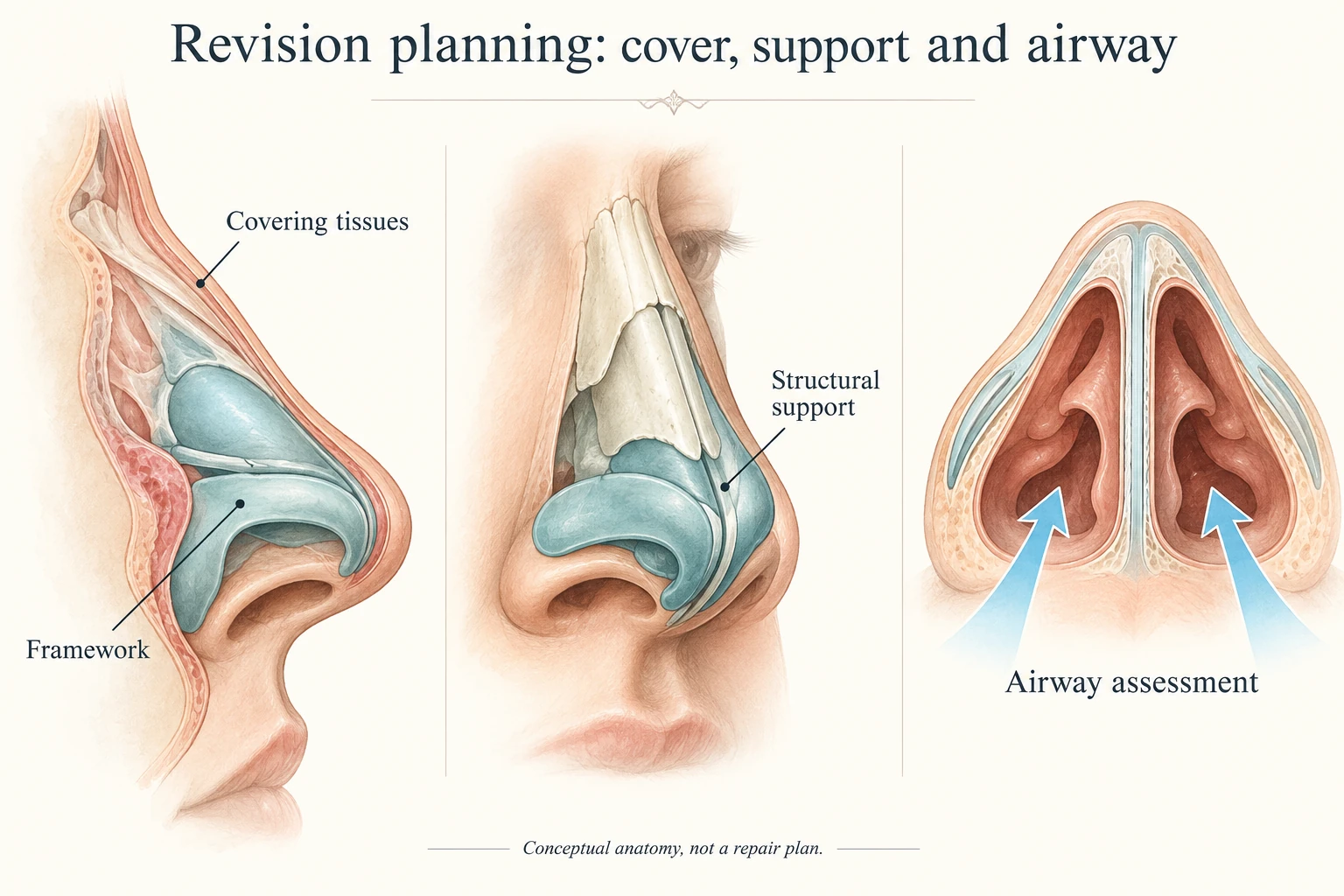
The drawing shows interactions, not a diagnosis
In the illustration, the covering tissue, supporting framework and nasal passage are shown as connected parts. A contour can look different because of more than one kind of change; a photograph alone cannot reliably identify which explanation applies. Scar tissue is one element the surgeon may assess, but it is not a universal explanation for every postoperative irregularity. Likewise, a firm area does not tell a patient whether it is scar, cartilage or another structure.
Use the diagram to ask three separate questions: What is known about the covering tissues? What is known about the support? What is known about function? Then ask how the proposed plan connects those findings. This is more educational than assuming that every concern can be solved by removing the visible prominence. The drawing is deliberately simplified and does not show a location for an incision, a graft size or a repair instruction. Those decisions belong to a clinical assessment.
Why adding support may belong in a refinement plan
Rhinoplasty can include adding cartilage as well as reshaping existing structures. ASPS describes septal cartilage and, when appropriate, other potential sources in its patient explanation. Rhinoplasty procedure. For a revision consultation, the useful question is the purpose of any proposed support, not whether adding material must mean making the nose look larger.
Ask what each graft or other structural step is meant to do: support an area, affect a contour, address a functional concern, or serve another stated role. Ask what source is being considered and why, including the implications of obtaining material from another site if that is proposed. The answer should distinguish the desired visible effect from the structural work intended to help achieve it. An anatomical explanation can reveal why a seemingly simple request is not a simple subtraction, without implying that every revision requires the same materials.
The skin envelope helps explain why contour is not just cartilage
The visible outline is produced by a supporting framework together with its overlying skin and soft tissue. A revision assessment therefore looks at both, rather than assuming that a contour seen from outside identifies a single piece of cartilage. The rhinoplasty clinical overview discusses the skin and soft-tissue envelope as part of surgical planning. Clinical overview.
Think of the diagram as showing a relationship: the covering tissue drapes over a framework, and both participate in what becomes visible. The analogy is limited—the nose is living tissue, not fabric—but it helps explain why making the framework different does not guarantee a particular visible edge or texture. Healing and previous treatment need assessment as well. This is also why a request to 'smooth this spot' may lead to questions about support, tissue conditions and whether further intervention is worthwhile. The explanation should make those connections clear without using scar tissue as a catch-all diagnosis.
Preserve, rebuild and refine can conflict
Suppose a hypothetical person wants a much narrower tip but also values the current profile and reports a functional concern. The consultation may reveal that pursuing one appearance request aggressively could conflict with another priority or with a structural requirement. A useful plan makes that conflict visible. It should not silently convert 'preserve my profile' into 'preserve it unless a different look makes a more dramatic photograph.'
Rank the goals before comparing two opinions. Mark each as essential, desirable or something you are willing to leave unchanged. Ask the surgeon to explain which goals can reasonably be addressed together and which need a compromise. You may discover that a smaller set of worthwhile changes fits your priorities better. You may also discover that the original desired change carries a burden you do not wish to accept. Both are meaningful outcomes of research; neither requires pretending that every aesthetic preference has a medically suitable solution.
Timing should distinguish healing, symptoms and scheduling
There are several reasons a surgeon may advise waiting or undertaking further assessment. Tissue conditions, the stability of the concern, a functional issue and the person's health may all belong in the discussion. Ask what the recommended interval is intended to clarify in your case. Avoid turning a commonly repeated internet waiting period into an individual clearance date. A schedule chosen for travel or work is a practical constraint, not evidence that the nose is ready for another operation.
Separate a persistent concern from a new or worsening symptom. If symptoms change, contact the treating team rather than waiting for a routine aesthetic review. Tell a revision practice if you are still under postoperative care elsewhere and provide the current instructions and relevant records. A useful consultation explains how those circumstances affect the next step. The question is not simply 'How soon can you book me?' but 'What needs to be understood before a decision is made?'
A surgeon comparison should include the tradeoffs
When two surgeons recommend different revision plans, begin with their explanation of the problem. Did they identify the same findings? Did one have records the other lacked? Are they trying to solve the same goals? A disagreement about a technique is difficult to interpret until those starting assumptions are clear. Request a summary of the proposed scope, important limits and alternatives, then use it to prepare follow-up questions.
Ask about relevant revision experience, where the procedure would take place, follow-up arrangements and management of complications or an unsatisfactory result. Verify credentials through the appropriate organizations instead of treating an award badge as a substitute. A practice's documentation and communication should help you evaluate the plan, but no portfolio can promise your own outcome. The stronger decision is based on the explanation, the safety arrangements and your understanding of the tradeoffs together.
Define success without a promise of perfection
A revision brief needs a realistic way to discuss success. Name the concerns the surgeon expects to address, the features you want preserved and the questions that may remain unresolved. If breathing is a goal, ask how it will be evaluated separately from appearance. If symmetry is a goal, ask what residual difference may remain. A single polished profile photograph cannot represent all of those outcomes.
Write down what would make further treatment worthwhile to you and what burden you would be unwilling to accept. That exercise can make an apparently attractive proposal less attractive, or help you understand why a limited plan meets your priorities. It also helps avoid a moving target in which one changed feature creates a new demand for a completely different nose. The purpose of the reconstruction brief is to connect a specific concern to a reasoned plan, with the uncertainty visible before consent.
A small-looking change can involve a larger problem
The size of a visible concern does not establish the complexity of correcting it. A contour, tip position or nostril relationship may be influenced by more than one structure. Previous surgery can also leave uncertainty about the remaining tissues and materials. In a consultation, ask the surgeon to explain the concern's possible components before discussing the preferred correction. A clinical review of revision surgery describes the importance of a systematic assessment of the previously operated nose. Read the revision assessment review. That is a better starting point than assuming another operation simply repeats the first with a minor adjustment.
Skin, support and airway belong in one conversation
Separate these domains on your notes, then ask how they interact. The skin and scar may affect how the underlying work becomes visible. Support can affect both shape and stability. Breathing symptoms need assessment of possible causes rather than an assumption that a cosmetic adjustment will solve them. The relationship between domains is why a photograph or one technique name cannot contain the full plan. Ask whether additional evaluation is needed, what remains uncertain and how the team will judge success in each domain. The original operation's records and a dated history can improve this discussion.
Timing should have a reason
An assessment and an elective operation are different decisions. You can ask for clarification while the result is still evolving, but readiness for another operation depends on the findings and intended work. If observation is recommended, ask what is being watched, how it will be compared and what would change the next step. New or concerning symptoms should be discussed with the clinical team rather than deferred because an online article mentions a waiting interval. A useful plan names both its decision checkpoints and the arrangements for earlier clinical help.
Compare revision surgeons by the quality of the brief
A consultation should leave you able to describe the problem, the proposed benefit, the uncertainties and the care responsibilities. Relevant revision experience, credentials and documented cases matter, but they are not a substitute for understanding your own recommendation. Ask how the surgeon would handle an unexpected finding and which parts of the plan are provisional. Before comparing quotes, establish whether different practices are addressing the same priorities. Revision rhinoplasty planning is strongest when it makes room for a smaller intervention, further assessment or no operation if those better fit the evidence and your goals.
A practical comparison worksheet
| Part of the brief | Patient question | Decision to clarify |
|---|---|---|
| Preserve | What is working that we should protect? | Boundaries around the intended change |
| Rebuild | What structural or functional job needs attention? | Reason for each reconstructive element |
| Refine | Which visible change matters most? | Expected benefit and relevant tradeoffs |
| Reassess | What is uncertain or still evolving? | Monitoring, more evaluation or intervention |
Questions patients ask
Does every revision rhinoplasty require rib cartilage?
Do not assume a material from the word revision. Ask what graft task is proposed, what material is available and why the surgeon recommends a particular source for your case.
Is scar tissue automatically a reason not to operate?
It is a factor to assess, not a diagnosis or universal rule. Ask how the tissue findings affect the proposed change and whether the benefit would justify the risks.
Can revision rhinoplasty restore my exact old nose?
A specific endpoint cannot be promised from a description or image. Discuss achievable priorities, limitations and the features you want preserved during an individual assessment.
Why might a surgeon discuss adding support when I want refinement?
A refinement goal can involve how the framework supports the covering tissues or nasal passage. Adding material may have a structural purpose rather than a goal of enlarging the visible nose. The surgeon should explain the reason, alternatives and implications of each proposed step.
Does a firm area after rhinoplasty prove there is scar tissue that needs removal?
No. A felt firmness or photograph does not identify its cause or establish that removing something is appropriate. Current tissue conditions, previous work and the overall support need examination. Ask which explanation is supported by findings and which remains uncertain.
Your next step
Explore revision rhinoplasty at Sedgh Plastic Surgery. Request a consultation with a Preserve–Rebuild–Refine brief and your prior records.
Sources and further reading
- Revision rhinoplasty assessment and planning review
- AAO-HNS rhinoplasty clinical practice guideline
- ASPS: Rhinoplasty risks and safety
- ASPS: Rhinoplasty procedure overview
- NCBI Bookshelf: Rhinoplasty
Educational information. An examination and an individualized discussion with an appropriately qualified surgeon are needed to assess options, risks and recovery.
Posted on behalf of Sedgh Plastic Surgery