

Most adult otoplasty research focuses on how far the ears project in a photograph. Your ears also spend the day interacting with glasses, a headset, a helmet, a pillow and the way you wear your hair. Those everyday details do not determine whether you need surgery, but they can make a consultation much more specific. They help you describe the concern, separate appearance from practical fit and prepare for the restrictions your own surgical team may set during recovery.
Explore this article
- The ear drawing explains what 'pinning' leaves out
- Shape and position should be assessed separately
- Why overcorrection belongs in the conversation
- The device problem is about contact, not just appearance
- A worked example: the all-day headset user
- Recovery milestones should identify what is being cleared
- Risks, hearing concerns and the right consultation
- Ear pinning is a nickname, not the whole plan
- The glasses conversation
- The headphone and headset conversation
- The helmet conversation
- Appearance goals still need more than one view
- Build a clearance list instead of borrowing a calendar
The ear drawing explains what 'pinning' leaves out
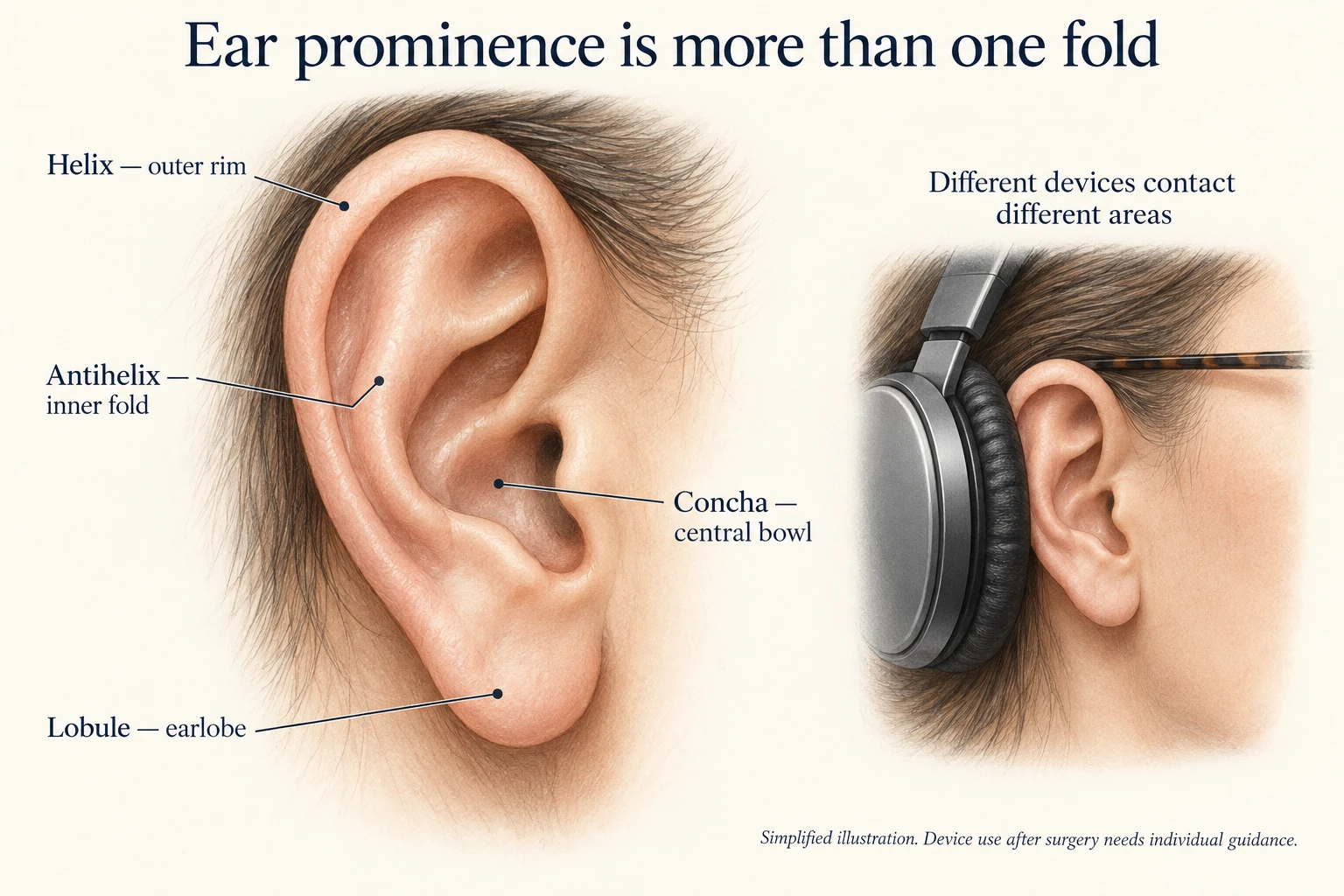
The helix is the outer rim of the ear. The antihelix is the fold inside it, with an upper branching shape. The concha is the deeper bowl leading toward the ear canal; the lobule is the earlobe. These features contribute different things to the visible ear. The illustration labels them so you can describe your concern without assuming that the entire ear simply needs to be pushed backward. External-ear anatomy.
An ear with a less-defined inner fold and an ear with a prominent conchal bowl may both stand out in a front view, but the underlying assessment is not identical. ASPS describes forming or increasing the antihelical fold and addressing enlarged conchal cartilage among the possible elements of otoplasty. Procedure explanation. That is the reason to ask which feature is contributing to your concern. A smaller ear-head distance is not the only visual objective; the shape of the folds and the balance of the upper, middle and lower ear matter too.
Shape and position should be assessed separately
Shape concerns the contours of the ear itself. Position concerns how it sits in relation to the head. A person may be satisfied with the shape but dislike visible prominence; another may be concerned about a fold or a difference between the two ears. The examination should distinguish those requests rather than translate every concern into the same setback. A technical discussion can then explain whether the proposed work concerns folding, the conchal relationship, another feature or a combination. Otoplasty clinical overview.
Compare front, side and rear views when discussing the goal. An ear can look less prominent from one angle without resolving the feature that bothers you from another. The earlobe also deserves its own discussion if it is part of the concern. Avoid choosing a maximum degree of setback from a photograph or an online measurement. The useful question is how the plan would address your particular shape and position while maintaining a natural relationship with the face.
Why overcorrection belongs in the conversation
The idea that ears should be as close to the head as possible can oversimplify the aesthetic goal. A balanced ear has recognizable folds and a relationship to the head; reducing prominence alone does not define an attractive result. ASPS notes that techniques are individualized with attention to avoiding distortion and an unnaturally pinned appearance. Otoplasty procedure information.
For your consultation, describe the amount of prominence that bothers you and what you like about your ears. Ask how the upper, middle and lower portions would be considered, and whether the two sides need different work. Do not treat a small difference as evidence that the entire face requires exact mathematical symmetry. A useful plan explains the desired change and the limits together. That explanation is more informative than a promise that both ears will become identical or disappear from the front view.
The device problem is about contact, not just appearance
The everyday equipment you wear contacts different parts of the ear. Glasses arms pass behind the upper ear. An over-ear headphone pad may press around the outer ear, while an in-ear device contacts a different area. A helmet can involve a strap, an interior pad or an edge near the ear. These are different situations, so the fact that one device seems comfortable does not establish that another is appropriate during recovery.
Bring the actual glasses or photographs of your essential equipment to the appointment and explain how long you use it. The team can then discuss a protection plan suited to the operation and its postoperative instructions. The purpose is not to choose a device that lets you ignore restrictions. It is to identify a conflict before surgery so that work, travel or recreation can be arranged around the care plan. A photograph of a helmet is useful information; a promise that you will simply wear it loosely is not a safety plan.
A worked example: the all-day headset user
Imagine an adult who wants assessment of prominent ears, wears prescription glasses and uses an over-ear headset for six hours of remote meetings. An appearance-only consultation could miss the practical conflict. A fuller brief would explain the work schedule, the visual need and the exact headset design. The questions become: which devices require a temporary alternative, what instructions apply to contact with the ear, and when will the team reassess their use?
A possible practical arrangement might be a different meeting format or time away from headset-dependent work, but the clinician must assess the actual situation. This is not a recommendation to substitute earbuds, speakers or another device after a particular number of days. The lesson is that the best scheduling decision may depend on a daily task that has nothing to do with the gallery photographs. Record the team's guidance for each important device rather than borrowing a clearance date from someone else's recovery story.
Recovery milestones should identify what is being cleared
A person may be able to carry out some daily activities while still needing to protect the ears from certain contact or trauma. A single 'back to normal' date cannot explain every work and recreational demand. Ask separately about required dressings or protection, sleep arrangements, eyewear, headphones, exercise and safety equipment. The operating team should state which guidance applies and how it may change at follow-up.
Create a short list of the tasks that matter most to you and leave the dates blank until the team provides them. Put the method of reassessment beside each task. That prevents a tentative estimate from becoming an automatic clearance. If a routine creates discomfort or a concern during recovery, contact the treating team rather than improvising pressure adjustments or modifying protective equipment. The point of the list is to make the instructions usable in real life, not to create a universal recovery schedule.
Risks, hearing concerns and the right consultation
Otoplasty is primarily a shape-and-position discussion; it should not be advertised as a general treatment for hearing problems. ASPS specifically distinguishes protruding-ear concerns from hearing loss in its overview. Ear surgery information. If hearing symptoms are part of your concern, describe them so that the practice can advise the appropriate assessment. Do not assume that changing the external appearance will resolve them.
Discuss scars, asymmetry, infection, healing problems and the possibility of further treatment as part of the surgical conversation, using the practice's explanation of your own risks. The consultation should connect the anatomy, your appearance goals and your daily equipment needs. It should also explain why the proposed plan fits the concern you brought. For adults researching otoplasty in Los Angeles, that combined explanation can be more useful than a page promising a fixed price and a universal return-to-work date.
Ear pinning is a nickname, not the whole plan
ASPS describes ear surgery as addressing shape, position or proportion. That is broader than treating every ear as something that simply needs to sit closer to the head. Ask the surgeon which part of your concern relates to projection, the ear's form or another feature. Ear size and earlobe concerns may raise different procedure questions. A consultation should explain what the proposed work would address and what it would leave alone. ASPS' ear-surgery explanation. Descriptive terms can help you talk about a concern, but they should not become a self-diagnosis from a mirror or selfie.
The glasses conversation
Bring your usual glasses, including the pair you need for work or driving. Tell the clinician where the frames rest, whether you experience a pressure point and what you hope surgery might change. The team can distinguish a frame-fitting issue from an ear-shape question and explain what they can assess. Ask about the postoperative plan for wearing the frames and whether you need an alternative arrangement. Do not assume that a change intended to reduce prominence automatically improves comfort, or that a generic online return date applies to every pair of frames and every operation.
The headphone and headset conversation
An over-ear cup, an on-ear pad and an in-ear device create different contact patterns. Bring the model you use daily or a photograph showing how it sits. Explain whether it is optional entertainment equipment or something required for work, communication or accessibility. Ask the surgeon how to plan around it during healing and which signs of pressure or discomfort should prompt you to stop and contact the team. This is a practical preparation exercise. The device test should not be used to diagnose cartilage anatomy or pressure-test a recently operated ear without clinical permission.
The helmet conversation
A cycling, motorcycle, sports or occupational helmet can introduce fit and pressure questions that ordinary photographs miss. Explain the activity, the equipment and whether the helmet is required for safety or employment. Ask what must be considered before you can return to the activity and use the equipment. Do not trade protective gear for a quicker return to your routine. If participation requires a helmet that cannot be worn under the team’s restrictions, the plan needs to address the activity as well as the device. Make this conversation part of scheduling rather than a surprise after surgery.
Appearance goals still need more than one view
Explain the views that bother you and the features you want to preserve. Ask how the surgeon considers differences between the two ears and what degree of symmetry is realistic. Bring ordinary photographs if they help communicate the concern, but avoid treating a particular camera angle as proof of a measurement. Ask to review relevant published cases and what was actually treated. Your assessment should also cover health, previous procedures and the risks of the proposed operation. Bleeding, infection, asymmetry, scarring and changes in sensation belong in the discussion, as appropriate to the plan. ASPS ear-surgery safety information.
Build a clearance list instead of borrowing a calendar
Make a list of work equipment, visual correction, exercise, sleep routines and any protective gear. For each item, ask the clinical team for a plan and the criteria for restarting it. A timeline given to another patient may reflect different work, tissue handling or healing. The value of the list is that it turns a vague question—when can I get back to normal?—into the activities that make up your actual life. Ask who to contact if a device causes an unexpected problem and how follow-up will work if you are traveling.
A practical comparison worksheet
| Bring or describe | Explain | Ask |
|---|---|---|
| Glasses | Where frames rest and whether they are essential | What is my postoperative plan for visual correction? |
| Headphones / headset | Contact pattern and daily use | When and under what conditions can I resume use? |
| Protective helmet | Activity, equipment and safety requirement | How does the recovery plan affect the activity? |
| Ordinary photographs | Views that bother you and features to keep | Which part of the concern would the operation address? |
Questions patients ask
Can adult otoplasty improve hearing?
Cosmetic correction of protruding ears is different from assessment or treatment of hearing loss. Discuss hearing symptoms with an appropriate clinician rather than expecting an appearance procedure to resolve them.
Will ear pinning make my headphones more comfortable?
That cannot be promised from the procedure name. Device fit and contact pressure need their own discussion, and postoperative restrictions may temporarily change what you can use.
Should I test my helmet after surgery to see if it fits?
Follow your own surgical team's instructions and obtain the relevant clearance. A preoperative equipment discussion is preparation; it is not permission to pressure-test healing tissue.
Why might two prominent ears need different adjustments?
The inner fold, conchal bowl and relationship to the head can contribute differently on each side. The aim is an assessed shape-and-position plan, not necessarily identical maneuvers. Several views help explain those differences, while the examination determines the appropriate work.
Can I use my headset as soon as my ears look healed?
Appearance is not a clearance test for pressure or device contact. Bring the equipment and explain your use before surgery, then follow the team’s device-specific guidance and reassessment. Glasses, an over-ear pad and a protective helmet contact different areas and should not share an assumed return date.
Your next step
Explore the practice's otoplasty information and request a consultation with your everyday equipment and a clear list of goals.
Sources and further reading
- ASPS: What is ear pinning and what does it do?
- ASPS: Ear surgery risks and safety
- ASPS: Ear surgery patient information
- NCBI Bookshelf: External ear anatomy
- NCBI Bookshelf: Otoplasty
- ASPS: Otoplasty procedure
- ASPS: Ear surgery overview
Educational information. An examination and an individualized discussion with an appropriately qualified surgeon are needed to assess options, risks and recovery.
Posted on behalf of Sedgh Plastic Surgery