

A mommy makeover can sound like one product with one price and one recovery. In reality, the phrase can describe a combination of different procedures with different goals, incisions and care responsibilities. The convenience of one booking is worth discussing, but it should not hide the clinical or practical questions. A good mommy makeover planning conversation makes each component visible, then asks whether combining, staging or choosing fewer interventions fits the person's health, priorities and support at home.
Explore this article
- A package name conceals procedures with different jobs
- Why liposuction and a tummy tuck are not substitutes
- A breast lift and an implant answer different questions
- Two studies can be about different versions of a 'combined procedure'
- One recovery period can contain overlapping restrictions
- A worked example: convenience versus support capacity
- Future pregnancy and ongoing weight change belong in the goal discussion
- An implant creates a longer care commitment than the initial booking
- Unpack the procedure list before the package
- What older and newer studies actually tell us
- One recovery contains several task demands
- Childcare is a care-plan question
- Compare combined and staged plans on more than cost
- Choose the right specialist for the body area
A package name conceals procedures with different jobs
A breast lift concerns position and shape; breast augmentation concerns added volume; breast reduction concerns reducing tissue as well as reshaping. A tummy tuck concerns excess abdominal skin and related contour work, while liposuction concerns selected fat deposits. Those are different mechanisms, so a list of procedures should be linked to a list of assessed concerns. The illustration separates the tasks rather than implying that a mommy makeover is one standardized operation. ASPS: Mommy makeover.
Begin with what bothers you, then ask the clinician which procedure addresses which finding. A concern about fullness is not the same as a concern about skin excess. A desire for a different breast position is not, by itself, a desire for an implant. You should not need to accept every item in a named bundle merely because the bundle is popular. Each component should have a purpose you understand and a tradeoff you consider worthwhile.
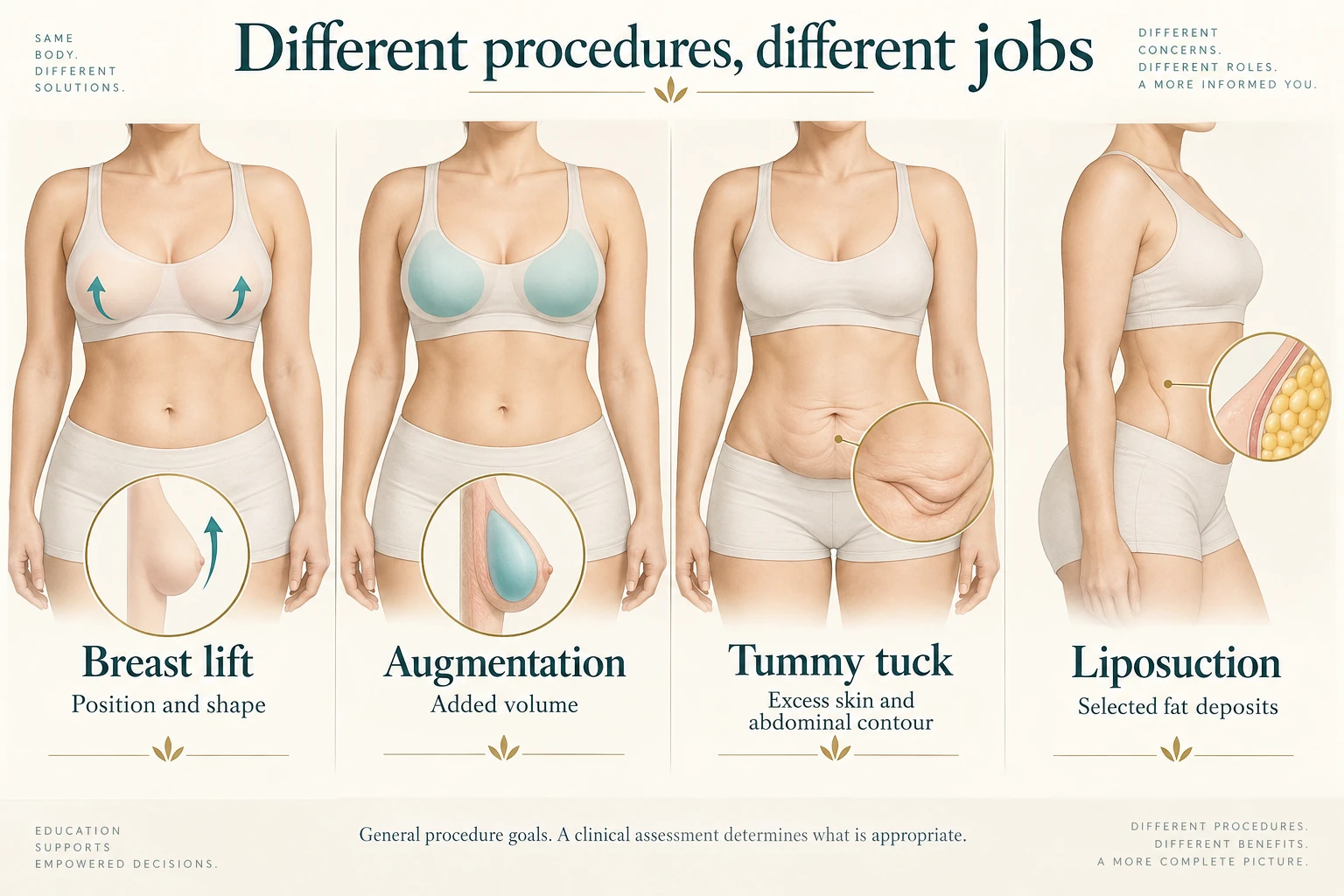
Why liposuction and a tummy tuck are not substitutes
Liposuction removes fat from selected areas; it does not perform the same skin-removal task as a tummy tuck. ASPS describes abdominoplasty as addressing excess skin and fat and, in many cases, weakened or separated abdominal muscles. It also states that the procedure is not a substitute for weight loss and does not remove all stretch marks. Tummy-tuck overview. The location of a stretch mark relative to skin that is actually removed matters.
This distinction can prevent an expensive mismatch between a goal and an operation. If a person's main concern is loose skin, the clinician should explain whether a proposed fat-removal treatment addresses that concern and what would remain. If the concern is a contour or bulge, its cause needs assessment rather than a diagnosis from a photograph. The goal is not to choose a tummy tuck yourself; it is to understand the reason for the proposed treatment and the limits of the alternative.
A breast lift and an implant answer different questions
A lift reshapes and raises the breast by addressing the tissue and skin arrangement. Augmentation adds volume through an implant or, in selected circumstances, another volume approach. The distinction helps explain why some plans discuss a lift, some discuss volume and some discuss both. ASPS notes that a breast lift does not by itself substantially change size or round out the upper portion in the way some patients desire. Breast-lift information.
Describe the desired change without beginning with a device: 'I want a different position,' 'I want more fullness,' or 'I want less volume.' Then ask what the examination supports. If an implant is proposed, it adds its own decisions and follow-up considerations; it should not disappear into the package name. If a lift alone is proposed, ask which volume expectations need to change. This is the kind of explanation that makes a procedure list educational rather than simply commercially attractive.
Two studies can be about different versions of a 'combined procedure'
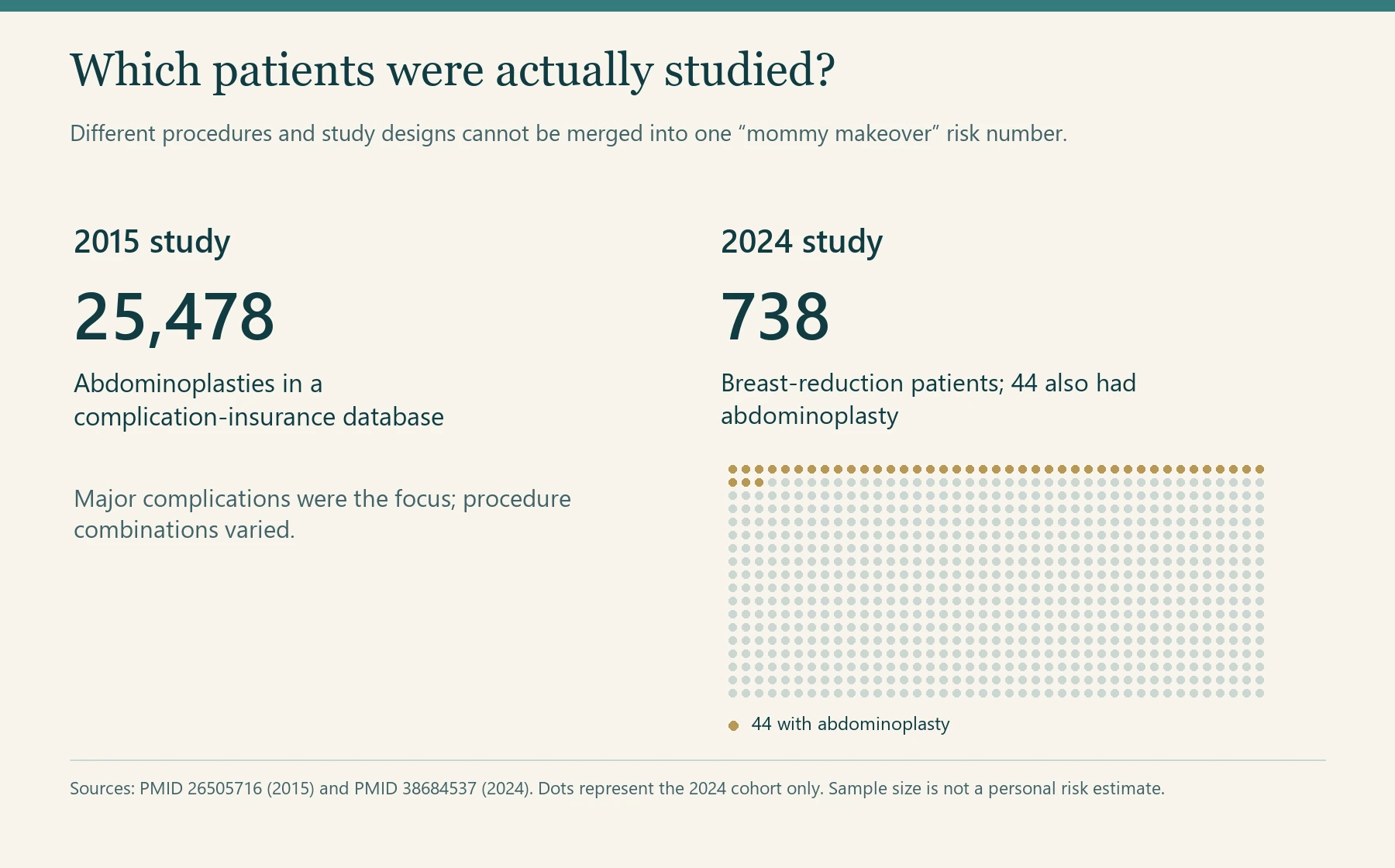
The studies discussed here do not test one universal mommy makeover. The 2015 study examined abdominoplasty and combinations within a complication-insurance database. The 2024 study examined breast reduction with or without abdominoplasty in a different setting. The operations, populations and outcome definitions differ, so their findings should not be merged into one package-risk percentage. 2015 study. 2024 study.
The evidence graphic makes those distinctions visible. A larger total sample does not mean every specific combination has that sample size. A finding about total complications is also not the same as a finding about revision surgery. To apply a study sensibly, first identify the actual combination being proposed, then ask whether the studied population and outcome are relevant. The surgeon should explain how personal health factors and the proposed work affect the decision. An article or graphic cannot calculate individual clearance.
One recovery period can contain overlapping restrictions
Combining procedures may mean one booking and one period away from ordinary routines, but it does not make the demands of each procedure disappear. The practical question is how the restrictions overlap. If the team limits lifting, a caregiver's tasks matter. If getting in and out of bed is difficult, the home setup matters. If driving must be deferred, appointment transport matters. The operating team must specify the actual instructions for the proposed combination.
Write down tasks rather than a vague promise that someone will 'help.' Who handles lifting a child, carrying a car seat, bathing a toddler, groceries, laundry, meals and transport? Which of those tasks belong to you when the helper returns to work? The worksheet is useful because it exposes a gap before surgery is scheduled. It does not assign fixed recovery dates or tell you which tasks are safe. Put the team's guidance beside each task, with a named person responsible for the alternative.
A worked example: convenience versus support capacity
Imagine a hypothetical parent who wants breast and abdominal assessment and prefers one period away from work. That preference is understandable, but the decision also depends on the proposed operations, health assessment and the home-support plan. A combined schedule may seem convenient on a calendar while placing several demands on the same helper. A staged schedule may require separate planning periods while changing the demands of each. Neither arrangement is automatically best.
Compare the complete care courses. Ask about the purpose and risks of each component, the expected practical restrictions, the follow-up arrangements and the financial terms for either approach. Then test the plan against the actual household. If a critical task has no reliable coverage, tell the team before booking. A clinically suitable plan and a practically feasible plan both matter; choosing on the number of appointment dates alone leaves important questions unanswered.
Future pregnancy and ongoing weight change belong in the goal discussion
A desire to proceed now should be discussed alongside expected future changes. ASPS' tummy-tuck guidance specifically addresses substantial future weight loss and possible future pregnancy as reasons to discuss postponement. Tummy-tuck patient guidance. That is one reason a surgeon asks about plans beyond the next few months. It is not a judgment about the right family decision, and a blog cannot tell an individual when to have surgery.
Explain your goals, likely weight trajectory, family plans and the practical pressures affecting timing. Ask what changes could alter the result or recommendation and which decision can reasonably wait. Keep facial concerns separate from breast and abdominal concerns when selecting the appropriate clinician. This article provides general education about body-surgery planning; the Sedgh practice's public menu focuses on facial procedures, so it should not be read as an offer of the body operations described here.
An implant creates a longer care commitment than the initial booking
If breast implants are part of a proposed plan, discuss their device-specific follow-up and risks separately from the package price. The FDA states that implants are not lifetime devices and that further operations may be needed. Its patient information includes rupture, capsular contracture and other complications. FDA implant information. The actual device and your clinical circumstances determine the discussion; a blog cannot select the implant or its surveillance plan.
Ask the breast-surgery clinician to explain the patient labeling, the follow-up arrangements and how a future concern would be assessed. Also ask what costs or responsibilities a device warranty does and does not cover. A warranty is not the same as a guarantee of a medical result or a complete future care course. This is a concrete reason to separate a desire for added volume from a decision to accept an implant: the latter adds a continuing care commitment beyond the first recovery.
Unpack the procedure list before the package
ASPS describes mommy makeovers as individualized combinations that may include breast procedures, liposuction, tummy tuck and other work. ASPS mommy makeover information. The name itself does not establish which operations are appropriate or whether they should be combined for you. For every component, ask what concern it addresses, what benefit you expect and what it adds to the recovery and risk discussion. A procedure that appears in a promotional package should still earn its place in your personal plan. Choosing fewer interventions is a valid option to compare.
What older and newer studies actually tell us
A 2015 database study assessed 25,478 abdominoplasty patients and reported differences in major-complication rates across procedure combinations. A 2024 single-center study included 738 breast-reduction patients, with 44 receiving a combined abdominoplasty; it found no significant increase in total complications but did find an increased risk of total revisions. 2015 study. 2024 study. These studies do not test identical populations, operations or endpoints. Neither provides a personal risk calculation. Their useful message is to ask which evidence applies to your proposed combination and which outcomes are being discussed.
One recovery contains several task demands
Build a practical list before agreeing on dates: getting in and out of bed, moving around the home, meals, transport, work, childcare and follow-up. Ask the clinical team how each proposed procedure affects those tasks and what support is needed. This is not a request for a universal return-to-normal timetable. It is a way to identify the actual responsibilities your recovery would create. A calendar that merely says 'time off' can conceal the most important issue: who will do the tasks you cannot safely do under your own instructions, and what is the backup plan if recovery takes a different course?
Childcare is a care-plan question
Describe the ages and needs of the children you support, the physical tasks involved and the adults available to help. Ask how your restrictions affect lifting, carrying, driving and routine responsibilities. Do not plan around the assumption that determination or convenience can override the surgical team's instructions. Make the support arrangement concrete, including nights, appointments and unexpected changes. If a proposed combined plan creates a burden your household cannot safely manage, ask how a staged or smaller plan would change that burden. Practical feasibility belongs in the clinical conversation rather than being treated as a private problem to solve after booking.
Compare combined and staged plans on more than cost
A combined plan and staged operations can have different anesthesia episodes, facility charges, time away from work, recovery periods and follow-up arrangements. Ask the team to explain the clinical rationale for each option, not simply the potential convenience or discount. Request written fee inclusions, rescheduling terms and the responsibilities if additional treatment or revision is needed. A lower visible total cannot tell you whether the plan suits your health or support situation. Keep both the care ledger and the financial ledger visible so a package comparison does not become a price-only decision.
Choose the right specialist for the body area
Verify training and certification relevant to the proposed breast, abdominal or other body procedures, review appropriate cases and confirm facility and anesthesia arrangements. The practice's public service menu emphasizes facial plastic surgery, including nose, face, neck and ear care. This educational article does not represent a breast or abdominal surgery offer from Dr. Sedgh. If your concern involves facial changes after pregnancy or weight loss, a facial consultation is a separate decision. For body procedures, seek the appropriate body-surgery assessment rather than assuming a facial specialist performs every operation described by the term makeover.
A practical comparison worksheet
| Planning layer | Combined-plan question | Alternative to discuss |
|---|---|---|
| Goals | Does each component address a priority I actually have? | Fewer procedures |
| Safety | Which evidence and personal factors affect this combination? | A different or staged plan |
| Daily life | Who covers the tasks restricted during recovery? | Different timing or more support |
| Care and costs | What follow-up, exclusions and contingency terms apply? | A complete comparison of care courses |
Questions patients ask
Is a mommy makeover one standardized operation?
No. The phrase can refer to different combinations. Ask for the exact procedure list and the rationale for each component in your own plan.
Does a combined plan always mean an easier recovery?
Convenience and recovery burden are different questions. The team should explain the restrictions and support needs created by the specific combination.
Does Dr. Sedgh offer the body procedures discussed here?
This article is general educational research. The practice's public menu focuses on facial procedures; it is not a body-surgery offer. Confirm the scope of any consultation with the practice.
Will a tummy tuck remove all abdominal stretch marks?
No. ASPS explains that stretch marks may be removed or improved when they lie within skin that is actually excised, but a tummy tuck is not an all-over stretch-mark treatment. Ask the clinician to relate the assessed skin-removal plan to the specific concern rather than inferring coverage from the procedure name.
Are breast implants a one-time lifelong purchase?
No. The FDA states that they are not lifetime devices and that further surgery may be needed. Device-specific risks, patient labeling, follow-up and possible future costs belong in the decision. A warranty does not guarantee a result or cover every aspect of future care.
Your next step
For facial concerns after weight loss or pregnancy, explore the practice's facial rejuvenation information and ask about a facial consultation. Breast and abdominal surgery require an appropriately qualified body-surgery clinician.
Sources and further reading
- ASPS: Mommy makeover overview
- Winocour et al., 2015: Abdominoplasty risk and combined procedures
- 2024 study: Breast reduction with abdominoplasty
- Sedgh Plastic Surgery public procedure menu
- ASPS: Tummy tuck
- ASPS: Breast lift
- ASPS: Liposuction
- FDA: Risks and complications of breast implants
Educational information. An examination and an individualized discussion with an appropriately qualified surgeon are needed to assess options, risks and recovery.
Posted on behalf of Sedgh Plastic Surgery