

The facelift market can sound like a ranking of techniques: one name is modern, another is limited, and a third is supposed to last longer. The evidence is less tidy than the advertisements. A technique label does not tell you the full extent of an operation, the surgeon's reasoning or how the plan relates to your anatomy. Before choosing a deep plane facelift, SMAS approach or smaller operation, ask what problem the plan is intended to solve and what the comparison actually establishes.
Explore this article
- First, understand what SMAS actually means
- What 'deep plane' adds to the explanation
- Why 'mini' is a scope question rather than an anatomical layer
- Read the evidence graphic as a filter, not a scorecard
- Separate a lift's task from volume restoration and skin treatment
- Three consultations can differ for sensible reasons
- A longevity claim needs a starting point and an endpoint
- Translate the risk vocabulary before comparing promises
- A useful statistic is hiding behind the headline
- New research adds information, not a personal promise
- Judge case evidence with the same discipline
- The risks and follow-up still belong in the comparison
First, understand what SMAS actually means
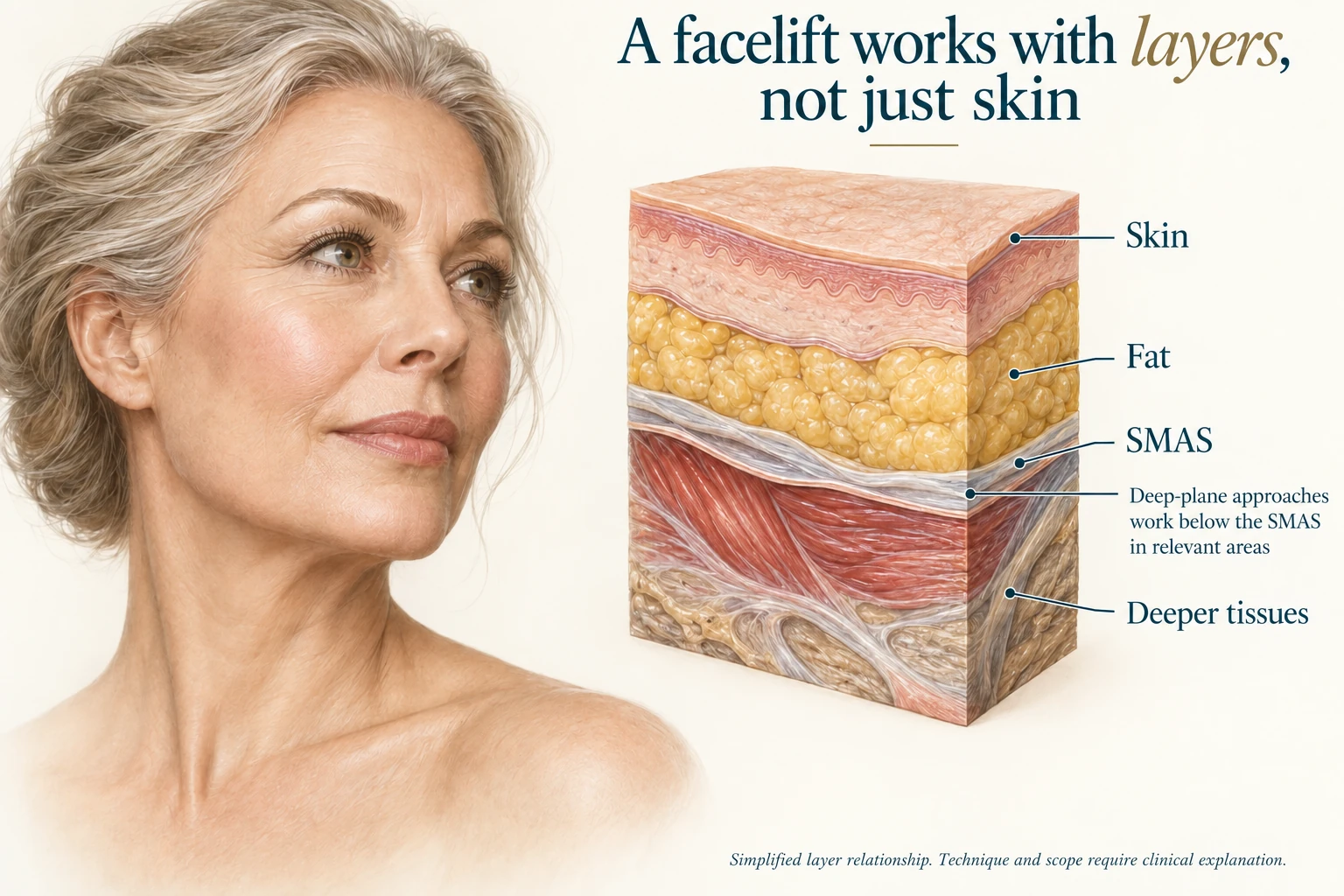
SMAS stands for superficial musculoaponeurotic system: a layer of tissue beneath the skin that is important in facial support and movement. It is a relevant structure, not one single operation. Different approaches may fold, remove part of, elevate or otherwise reposition tissue in relation to that layer. The fact that two surgeons both describe a SMAS approach does not establish that they propose identical work. Facelift clinical overview.
In plain English, the label tells you something about the supporting tissue being addressed, but not the whole treatment scope. You still need to know which areas are included, what the surgeon intends to change and how the skin is managed. This is why a technique comparison should begin with the actual operation rather than a three-column marketing ranking. A family of procedures cannot be evaluated as though it were one standardized product with one recovery and one durability number.
What 'deep plane' adds to the explanation
A deep-plane approach works beneath the SMAS in relevant areas and can mobilize a composite of overlying tissues rather than treating skin repositioning as the whole task. The clinical description also discusses release of retaining structures to permit movement. Deep-plane overview. The diagram illustrates the layer relationship in a simplified way; it intentionally omits nerves, dissection boundaries and surgical instructions.
That mechanism can explain why a surgeon considers the approach for a particular set of concerns. It does not, by itself, prove that it will produce the best result for every person. A mechanism is a reasoned account of how an operation works; comparative effectiveness requires suitable outcomes research. Keep those questions separate. Ask how the proposed approach relates to your findings, then ask what evidence supports the benefits and limitations being claimed. Neither a dramatic diagram nor an enthusiastic technique name can replace that explanation.
Why 'mini' is a scope question rather than an anatomical layer
Deep plane and SMAS refer to relationships with supporting tissues. 'Mini' usually communicates some idea of limited scope, but it does not define the same operation across all practices. A comparison that places all three labels on a single ladder of strength can therefore be misleading. You may be comparing a tissue approach with a description of extent, rather than three mutually exclusive procedures.
Request a plain-language description of the areas treated, incision plan, tissue work and concerns left outside the operation. If a smaller procedure is proposed, ask why that scope is appropriate and which limitations matter. A limited plan may fit a limited goal; it may also leave another goal unaddressed. The useful decision is about that fit. Avoid concluding that 'mini' must mean no meaningful recovery or no important risks, just as you should avoid concluding that a more extensive name must be the superior choice.
Read the evidence graphic as a filter, not a scorecard
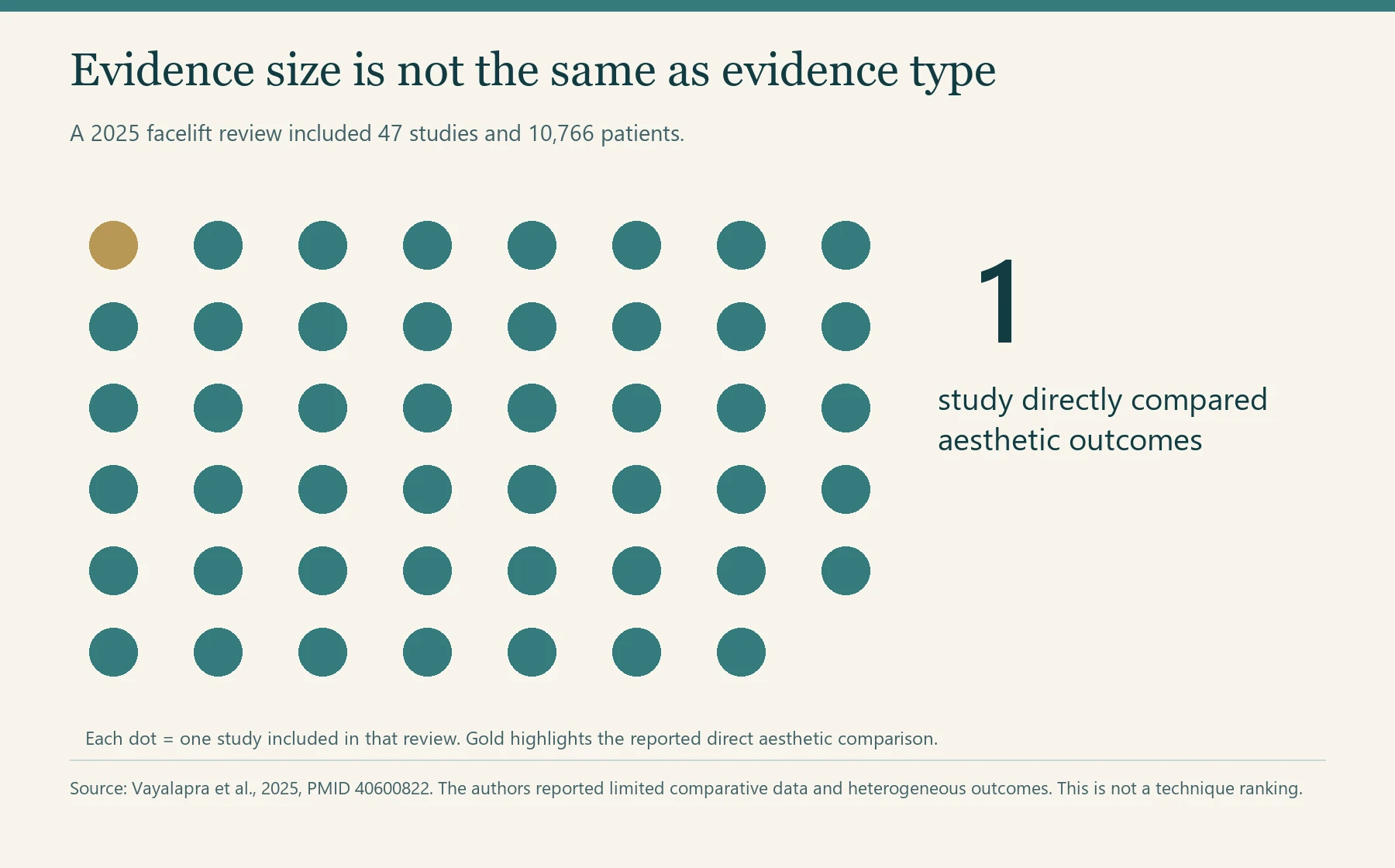
The 2025 review's large combined patient count can look decisive in a headline. Its report that only one study directly compared aesthetic outcomes is a different kind of information. The graphic shows how much of the apparent evidence pool should not automatically be interpreted as a direct aesthetic contest between techniques. It does not mean the remaining studies are worthless; they may inform other questions. 2025 review.
For any comparison, identify the outcome: patient satisfaction, complications, a photograph-based rating, recovery or something else. Then identify how it was measured and how long participants were followed. A study can address one of those outcomes without establishing all the others. An operation with an attractive short-term photograph is not thereby proven more durable, and an absence of one reported event is not proof of zero risk. The practical benefit of the graphic is to slow down an unsupported leap from 'many patients studied' to 'this technique is best for me.'
Separate a lift's task from volume restoration and skin treatment
A lift addresses selected changes in the position and contour of facial tissues. Restoring fullness is a different question, and treating surface quality is another. ASPS describes additional procedures that may accompany facelift surgery, while noting important limits to what a facelift alone achieves. Facelift patient overview. When a plan includes more than a lift, the result should not be attributed to the technique name alone.
For a hypothetical gallery case that includes a facelift and a volume treatment, ask what work the caption documents. Do not assume that the observed cheek fullness comes from lifting alone. Similarly, do not use smoother-looking surface texture to rank two lifting techniques when lighting, makeup or additional skin treatment may differ. A clear gallery caption helps you understand the combination; your own examination determines which concerns, if any, require a comparable combination.
Three consultations can differ for sensible reasons
Suppose a hypothetical patient identifies jawline contour as the main concern but also mentions cheek hollowing and uneven skin texture. One consultation may focus on the jawline, another may propose volume treatment as well, and a third may discuss skin care or a separate surface procedure. Before deciding that the surgeons disagree about the best facelift, check whether they are addressing the same goals and proposing the same scope.
Ask each clinician to rank the concerns and identify which part of the plan treats each one. Then compare alternatives, important risks and follow-up rather than merging every recommendation into a larger package. A broader proposal is not automatically more complete in a useful sense; it may include a goal you do not value enough to pursue. The point of the exercise is to turn a technique-shopping conversation into a comparison of explained, individualized plans.
A longevity claim needs a starting point and an endpoint
When someone says a facelift lasts a certain number of years, ask what 'lasts' means. Does it refer to a patient's satisfaction, a maintained change in a photograph, the time before further treatment or a surgeon's impression? Also ask which procedure or combination is being discussed. Those are different endpoints, and none means that aging stops. A single lifespan number can obscure that distinction.
The same approach applies to recovery claims. Ask what activity the estimate describes and what the team will reassess before clearance. Returning to a desk task, appearing at an important event and returning to strenuous activity are not interchangeable questions. A useful consultation does not need to offer certainty about every future year. It needs to explain the likely course and the limits of the evidence in terms that relate to your actual priorities.
Translate the risk vocabulary before comparing promises
A hematoma is a collection of blood beneath tissue; a seroma is a fluid collection. Those terms describe problems that may need clinical treatment, not just an unattractive photograph. Facial nerve injury concerns weakness, while altered skin sensation concerns feeling; they are not interchangeable outcomes. The Aesthetic Society and ASPS list these and other considerations in their patient guidance. Facelift safety considerations. ASPS risks.
A useful risk conversation explains which events are relevant to the proposed operation, how they are recognized and how the team responds. An average percentage from a different series does not define your own likelihood, and 'no permanent nerve injuries observed' in a study does not mean an event is impossible. Ask which outcome a reported number measures and what follow-up supports it. You should also know whom to contact for a new or worsening postoperative concern. Technique selection, the person's health and the complete care setting belong in the discussion together.
Keep the goal in view while considering these tradeoffs. The comparison is not simply whether a name sounds advanced; it is whether the expected benefit of the explained operation is worthwhile to you alongside its risks, limits and recovery. A surgeon should be able to discuss that without suggesting that a modern label eliminates the need for informed consent.
A useful statistic is hiding behind the headline
A 2025 systematic review and meta-analysis included 47 studies with 10,766 patients, yet the authors reported that only one study directly compared aesthetic outcomes between the approaches. They concluded that limited comparative data and heterogeneous outcome measures prevented definitive conclusions about relative efficacy. Read the review. That distinction matters: a large patient total is not automatically a large, controlled head-to-head comparison. Ask what a claim of superiority is based on, which outcome was measured and whether the evidence applies to the operation being proposed to you.
New research adds information, not a personal promise
A 2026 review of deep plane facelift studies included 45 studies and 10,784 patients. Its authors described favorable outcomes while calling for further randomized studies, standardized measures and longer follow-up. Read the 2026 review. A review can help characterize reported experience, but its pooled findings do not establish your individual risk or guarantee a particular result. Different study populations, techniques, definitions and follow-up periods can affect what is being combined. A responsible consultation explains these limits rather than turning a pooled percentage into a promise.
Judge case evidence with the same discipline
Ask for several relevant documented cases, comparable views and meaningful follow-up. Clarify what procedures were combined, because an apparent facelift result may also reflect other work. Discuss the timing of the photographs and which changes the surgeon expects to persist or evolve. A single polished image does not reveal the entire care course, recovery or complication history. Use the gallery to ask better questions and assess whether the practice's documented results fit your goals; do not use it to calculate your own likelihood of looking identical to the photographed patient.
The risks and follow-up still belong in the comparison
Ask which risks matter for your health and proposed operation, where surgery takes place, who provides anesthesia and how unexpected concerns are handled. Discuss scars, recovery responsibilities and the plan if the result is not what you expected. A technique's attractive name should not move these questions to the fine print. Request the scope and care arrangements in writing so you can compare consultations thoughtfully. ASPS' facelift safety guidance provides a starting point for the risk discussion, but your clinician should relate it to your individual circumstances. Facelift risks and safety.
A practical comparison worksheet
| Instead of asking only… | Ask… | Why it helps |
|---|---|---|
| Which technique is best? | Which problems does this plan address in my case? | Connects the label to your goals |
| Which percentage is highest? | Were the studies directly comparable? | Separates pooled reports from a head-to-head test |
| How long does it last? | What follow-up supports the claim? | Makes the time horizon visible |
| Is a mini procedure easier? | What exact work and recovery are proposed? | Defines scope rather than relying on a nickname |
Questions patients ask
Does the latest review prove deep plane facelifts are best for everyone?
No review establishes suitability for everyone. The studies, outcome definitions and comparison methods matter, and an individual recommendation requires clinical assessment.
Is 'mini facelift' a complete description of the procedure?
Ask the practice to define the exact areas and tissue work included. A label cannot substitute for a clear explanation of scope, limitations and recovery.
Can I choose an approach from before-and-after photographs?
Photographs can help evaluate documented cases, but they do not reveal all the work performed or determine which approach fits your anatomy and health.
Is SMAS one standardized facelift operation?
No. SMAS names an important tissue layer; different operations address it in different ways. Deep plane describes a relationship below it in relevant areas, while mini describes limited scope that needs definition. Compare the actual proposed work and its fit with your goals rather than treating the labels as a universal ranking.
Does a large meta-analysis prove one facelift lasts longer?
Not by sample size alone. You need to identify the outcome, the comparison method and the duration of follow-up. Aesthetic ratings, patient satisfaction, complications and later treatment are different endpoints. The 2025 review discussed here reported limited direct aesthetic comparisons despite a large combined sample.
Your next step
Explore the practice's facelift information and request a consultation focused on your priorities, the proposed scope and the evidence behind it.
Sources and further reading
- Vayalapra et al., 2025: SMAS and deep plane facelift systematic review
- Koroma et al., 2026: Deep plane facelift systematic review
- ASPS: Facelift risks and safety
- NCBI Bookshelf: Cervicofacial rhytidectomy
- NCBI Bookshelf: Deep plane facelift
- ASPS: Facelift overview
- The Aesthetic Society: Facelift safety considerations
Educational information. An examination and an individualized discussion with an appropriately qualified surgeon are needed to assess options, risks and recovery.
Posted on behalf of Sedgh Plastic Surgery