
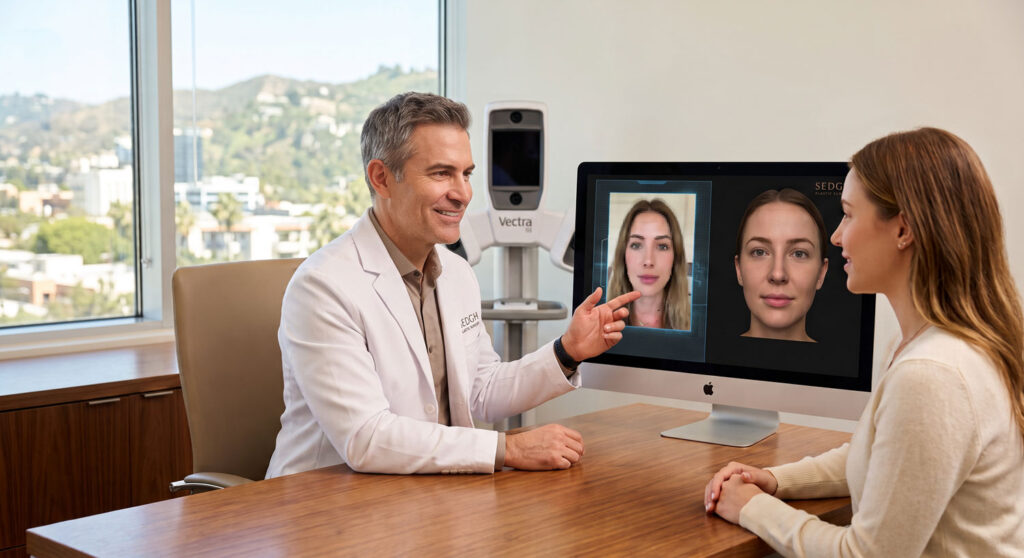
A plastic surgery simulator can help you discuss preferences, but it cannot replace a clinical examination or guarantee a surgical result. For nasal surgery, start with the Los Angeles rhinoplasty guide or revision rhinoplasty assessment.
Dr. Jacob Sedgh uses consultation and imaging to discuss your goals at his West Hollywood practice, serving Los Angeles and Hollywood. Request a consultation to review your own options.
Key Takeaways: Why AI Can’t Replace a Real Consultation
- Pixels vs. Anatomy: Plastic surgery simulator apps modify 2D pixels; they cannot assess skin thickness, cartilage strength, or underlying bone structure.
- Risk of Impossible Expectations: A filter may suggest a shape that does not suit your features or cannot be achieved with surgery.
- Vectra 3D Advantage: Clinical technology like the Vectra 3D system uses multi-camera capture and surgeon guidance to discuss possible changes. A simulation is a planning aid, not a guarantee of the result.
- Holistic Medical Evaluation: An in-person plastic surgery consultation factors in your medical history, healing tendencies, skin quality, and long-term aging process.
- Human Connection & Real-Time Adaptability: A consultation lets you explain your goals and ask the treating team questions.
Jump to a Section:
- Digital Simulators vs. In-Person Consultations
- Simulators Edit Pixels; Plastic Surgeons Understand Anatomy
- The Danger of Unrealistic Expectations
- The Vectra 3D Camera: Clinical Expertise Meets Technology
- Medical History and the Science of Healing
- The Dynamic Reality of the Operating Room
- The Value of the Doctor-Patient Relationship
- Ready to See What’s Truly Possible?
The Role of Simulation in Surgical Planning
A photo app can help you describe a change you have in mind. You might use it to compare a profile or show the direction of a change. Treat the image as a starting point for questions.
A simulation does not decide whether surgery is suitable. It cannot promise your healed result. The consultation should explain the options and the limits for your own case.
Digital Simulators vs. In-Person Consultations
Each tool has a different role. An app edits an image. A clinical visit combines your goals with an examination and a review of your health history.
What a photo app can help with
- Explore changes before an appointment.
- Identify which features you want to discuss.
- Show the surgeon what you like about an image.
What a photo app cannot establish
- Whether the proposed change is suitable for your anatomy.
- Which operation, if any, is appropriate.
- How your breathing or healing will be affected.
- The exact result you will have after surgery.
What to expect from a clinical visit
Explain your goals and concerns. Ask the surgeon to assess the relevant features and discuss the plan. You should also have time to ask about risks, recovery and alternatives.
Planning time for the consultation
An appointment takes more time than editing a selfie. Bring your questions, medical history and records of earlier surgery when available. The surgeon may advise that a change shown in your image is not appropriate for you.
| Feature | Plastic Surgery Simulator Apps | In-Person Plastic Surgery Consultation |
|---|---|---|
| Main role | Edit a photo to explore ideas. | Assess your concerns and discuss treatment options. |
| Medical history | An image alone does not provide it. | Discussed with the treating team. |
| Physical examination | Cannot be replaced by a selfie. | Helps assess the relevant anatomy. |
| Outcome | The edited image is not a promise. | The plan includes goals, risks and limits. |
| Questions | May help you describe a preference. | You can ask the surgeon about your own case. |
A Photograph Does Not Replace an Examination
A photograph shows the surface of your face. It does not provide the same information as an examination of the nose. For rhinoplasty, appearance and breathing concerns may both need assessment.
Tell the surgeon about prior injury, surgery or nasal obstruction. Ask why a specific approach is proposed. A small change on a screen does not explain the work needed in an operation.
Set Goals Around Your Own Features
Describe what you like about an edited image. Is it the bridge, tip, profile or balance with another feature? Also explain what you want to preserve.
Ask which changes are realistic for your face. Avoid treating someone else’s nose or an app’s output as a required result. Your preferences and anatomy should guide the discussion.
How Vectra 3D Imaging Helps the Conversation
Clinical 3D imaging can show facial contours from different angles and support a discussion of possible changes. Canfield Scientific’s Vectra information describes tools for viewing a 3D image and comparing it with a simulation.
At Sedgh Plastic Surgery, imaging is used alongside the consultation. It is a communication and planning aid. It does not replace a physical examination or guarantee an outcome.
- Review the views. Discuss the front, profile and other angles relevant to your goals.
- Explain your preferences. Describe the changes you want and the features you wish to keep.
- Ask about feasibility. Which simulated changes are appropriate, and which may not be achievable?
- Discuss uncertainty. Ask how anatomy and healing could affect the final result.
Your Health History Matters
Bring a list of medicines and supplements. Discuss prior operations, health conditions and tobacco or nicotine use. Tell the team about any concerns that may affect treatment planning.
Your surgeon will explain which information, tests or other assessments are needed. Do not change prescribed medicines based on a simulation or general online advice. Follow the instructions given for your care.
Discuss the Plan and Its Limits
An operation is not the same as changing a digital image. Ask which techniques may be used and what could change the plan. Discuss the risks and alternatives before deciding.
The rhinoplasty treatment guide and revision evaluation page can help you prepare questions.
Make Space for Questions
A consultation should help you understand the proposed care. Share any concerns about appearance, breathing, recovery or follow-up. Ask for an explanation if a term or recommendation is unclear.
Confirm who you can contact after the appointment. You should understand the next steps and have time to consider your options.
Plan Your Los Angeles & Hollywood Consultation
Dr. Jacob Sedgh sees patients in West Hollywood, serving Los Angeles and Hollywood. Bring your questions and, if helpful, an image that illustrates a preference. The goal is to discuss an individual plan.
Request a consultation or call 310-888-2884 to discuss the next step.
Posted on behalf of Sedgh Plastic Surgery