

After substantial weight loss, the body you worked toward and the face in the mirror may seem to be telling different stories. It is easy to describe every facial change as loose skin—or to assume everything needs more volume. A useful assessment starts by separating the questions. What has changed in fullness? What has changed in tissue position or contour? What concerns belong to skin surface quality? These distinctions can turn a confusing search for a facelift after weight loss into a more focused consultation.
Explore this article
- Hollowing and sagging are different visual questions
- What filler, fat grafting and lifting do differently
- Fat transfer is not simply a permanent version of filler
- Growth statistics describe interest, not what your face needs
- An ongoing weight change can change the planning conversation
- A worked example: the person who notices both cheeks and jawline
- Separate restoration from returning to a past photograph
- The growth data shows interest, not a diagnosis
- Surface: what does the operation not address?
- Your weight trajectory is part of the history
- Make a goal map before comparing packages
Hollowing and sagging are different visual questions
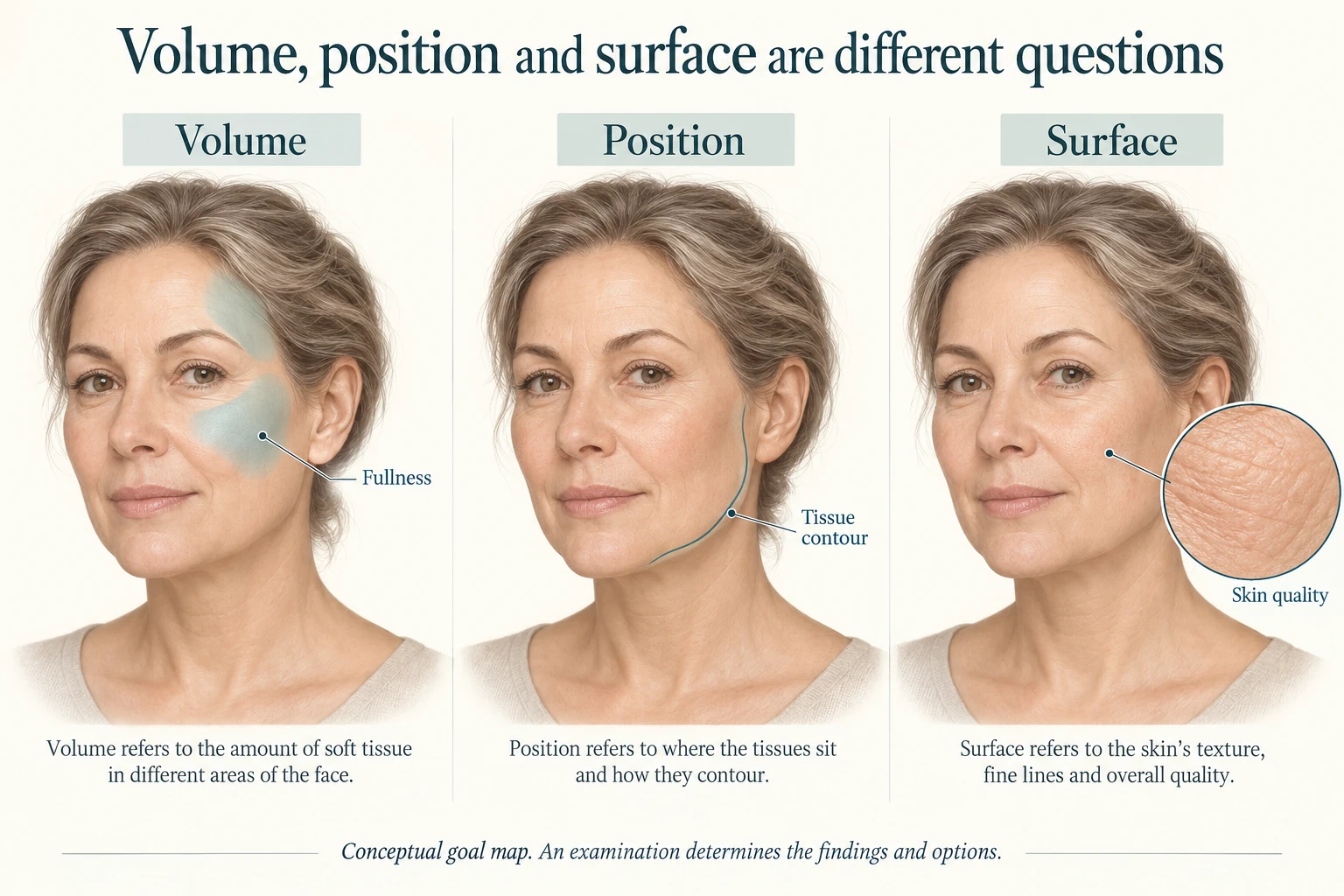
Fullness describes volume; position describes where tissue sits; surface describes qualities such as texture. After substantial weight change, a person may notice concerns in more than one domain. That does not mean every hollow area needs filling or every shadow needs lifting. The drawing separates the domains so you can explain what you are noticing before a clinician decides what the findings represent. ASPS' body-contouring overview includes facial sagging among the concerns that may follow major weight loss. Patient information.
A practical observation might be 'My cheeks seem less full in photographs' or 'My jawline contour has changed.' Keep those observations separate from the proposed solution. A shadow can reflect more than one relationship, and an image alone may not distinguish them. The useful examination explains which concern is primarily about volume, which about position and which remains a surface issue. That distinction helps prevent a list of products or procedures from arriving before the problem is understood.
What filler, fat grafting and lifting do differently
A volume treatment and a lift have different primary tasks. Injectable fillers add material to selected areas. Fat grafting transfers the person's own fat to a planned recipient area; it involves a harvesting step as well as placement. A lift changes selected tissue position and contour. Those distinctions explain why the treatments should not be presented as interchangeable answers to every post-weight-loss facial concern. ASPS: Fat injections.
If volume treatment is suggested, ask which area it is intended to address and what limitation it leaves. If lifting is suggested, ask what would remain hollow or unchanged. If both are proposed, ask why the combination is useful and whether the parts can be considered separately. A carefully explained limited treatment can be easier to evaluate than a bundle described as 'full facial restoration.' The name of a package does not establish that all three domains of volume, position and surface have been addressed.
Fat transfer is not simply a permanent version of filler
Using the person's own fat changes the nature of the procedure: the material is harvested and transferred, and the result is affected by healing and retention. ASPS explains that fat transfer involves more than a simple filler injection and that the amount of fat that survives is variable. Fat-injection overview. Avoid converting a claim about a material into a promise about an exact lasting volume.
For the decision, ask about the donor area, the treatment's expected limitations, follow-up and the possibility of further treatment. Also explain your weight trajectory rather than assuming it is unrelated to the face. The clinician can discuss whether the current timing makes sense and how future change may affect the plan. The useful comparison is not 'Which material sounds most natural?' but 'Which approach addresses my assessed concern, with tradeoffs I understand?'
Growth statistics describe interest, not what your face needs
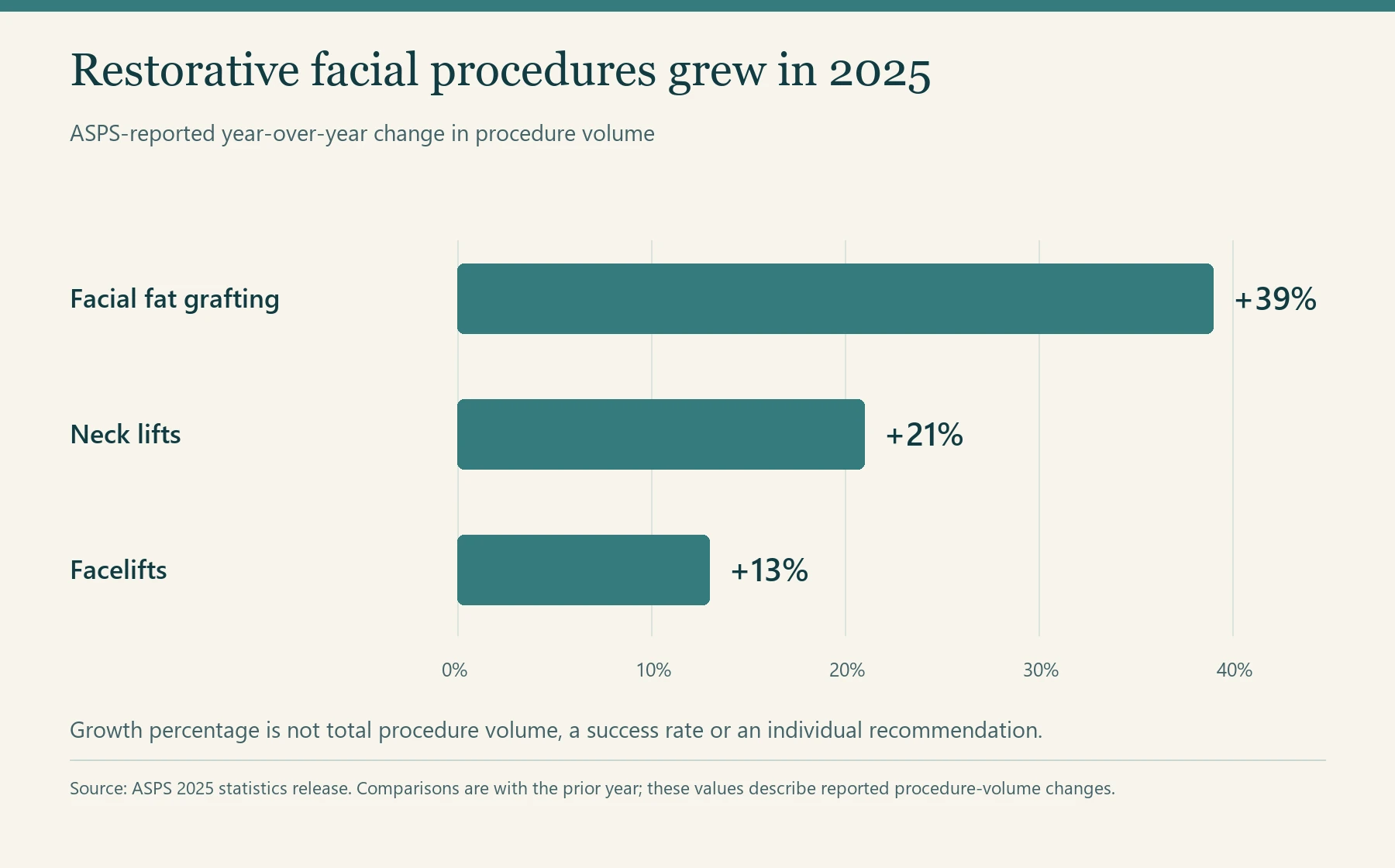
The chart displays the ASPS-reported year-over-year changes for facial fat grafting, neck lifts and facelifts in 2025. The biggest percentage increase does not necessarily identify the procedure with the largest total volume. Nor does it measure which treatment produces the best result for a particular patient. A small baseline can produce a large percentage rise, so percentage growth and absolute popularity need to be kept separate.
Use the chart to understand why you may be hearing more about restorative procedures, then return to your examination and goals. The ASPS statistics report discusses facial consultations in the context of weight-loss trends, but a trend cannot establish that a medication caused an individual person's facial change. 2025 statistics report. Be cautious with the nickname 'Ozempic face': it can collapse a complex personal history into a label and make a treatment seem predetermined when it is not.
An ongoing weight change can change the planning conversation
Tell the clinician whether your weight is stable, still changing or expected to change, and explain the reasons and timeframe. That information helps make the planning discussion more realistic. A treatment selected for today's appearance should not be discussed as though the future appearance is already fixed. Avoid borrowing a universal stable-weight interval from a body-contouring article and applying it to every facial procedure.
Bring your medication list, including weight-management treatment, to the surgical and anesthesia teams. Ask the prescribing clinician and operating team to coordinate any perioperative instructions; do not change a medicine because of a cosmetic-surgery blog. This is a coordination issue, not a one-line stopping rule. If your circumstances change after consultation, update the practice before the operation is scheduled. A carefully timed plan begins with an accurate account of your health and current treatment rather than a fashionable nickname for the face.
A worked example: the person who notices both cheeks and jawline
Imagine a hypothetical patient who reports less cheek fullness and a softer jawline after weight loss. A photograph may make the two changes feel like one problem. The consultation should test that impression. If the examination identifies separate volume and position concerns, the explanation should state how each proposed option addresses its assigned task and what happens if only one is pursued.
A useful comparison might include doing less, addressing one priority first, considering a combined approach, or waiting while the history becomes more stable. Those are possibilities to discuss, not recommendations for this hypothetical person. What makes the example useful is the structure: two observations, findings from examination, options with separate mechanisms, and a decision based on ranked goals. 'I need the treatment everybody is getting after weight loss' skips the steps that make an individualized decision possible.
Separate restoration from returning to a past photograph
A past photograph can explain what feels different, but it is not a guarantee of what any procedure can restore. Age, expression, lighting and the rest of the face also differ across time. Identify the specific relationship you miss: cheek fullness, a particular contour or skin quality. That gives the clinician something more concrete to evaluate than a request to recreate an entire earlier face.
For a gallery case, check which procedures were performed and the follow-up timing. Do not attribute every visible difference to one treatment or use the case to calculate your own likely result. The strongest research journey ends with an explanation of your assessed concerns, the reasonable options and the practical care course. It should leave you better able to choose, including choosing not to proceed, rather than more anxious to buy a restoration package.
The growth data shows interest, not a diagnosis
ASPS' 2025 statistics release reported increases of 39% for facial fat grafting, 21% for neck lifts and 13% for facelifts. These are changes in reported procedure volume, not the proportions of weight-loss patients who need each treatment. ASPS 2025 release. They provide context for why restorative discussions are attracting attention. They do not establish that weight-loss medications caused every change or that a popular procedure is appropriate for your face. Keep market trends separate from your clinician's assessment.
Surface: what does the operation not address?
Texture, fine lines, pigmentation and other surface concerns need their own discussion. Ask which goals belong to the surgical plan and which may require separate evaluation or treatment. This helps prevent disappointment caused by expecting one operation to solve every aspect of facial aging or weight-related change. It also makes a combined recommendation easier to assess: why is another intervention being proposed, what does it add and could the decisions be separated? Keep your main priority visible so the appointment does not become an open-ended shopping list.
Your weight trajectory is part of the history
Tell the team whether your weight is still changing, what health conditions or medications are relevant and what future changes you expect. The clinician can explain how that history affects assessment, timing, preparation and follow-up. Do not stop or alter a weight-loss medicine because a cosmetic article suggests doing so; medication decisions and anesthesia preparation need coordination with the appropriate clinicians. If timing is uncertain, ask what information or findings would make the next assessment more useful. A booked date should not replace a reasoned readiness decision.
Make a goal map before comparing packages
Create three columns headed Volume, Position and Surface. Put each concern where you think it belongs, but mark uncertainty rather than forcing a diagnosis. Add the features you want to preserve and the change that would matter most to you. Bring the sheet to consultation and ask the surgeon to correct the map. This exercise is useful because it exposes mismatches: you may be asking a lift to provide fullness or asking a volume treatment to address a positional concern. It also gives you a way to understand why two consultations recommend different combinations.
A practical comparison worksheet
| Domain | Describe | Ask the clinician |
|---|---|---|
| Volume | Changes in fullness and prior treatments | Is volume part of my concern, and where? |
| Position | Contours or tissue relationships that bother you | What would the proposed lift address? |
| Surface | Texture, fine lines or pigmentation questions | Which goals sit outside the operation? |
| Timing | Weight changes, health and medications | What would establish readiness for this plan? |
Questions patients ask
Does everyone who loses weight need a facelift?
No. Weight loss does not determine a procedure. An individual assessment should establish the concerns, appropriate options and whether any intervention would be worthwhile.
Is 'Ozempic face' a diagnosis?
The phrase is an informal label, not a complete clinical assessment. Describe the actual changes, weight history and relevant medication use to your clinician.
Should I choose filler or a facelift after weight loss?
Start with the cause and goals of the concern. Ask how volume and tissue-position questions differ in your case before choosing between treatment names.
Can adding facial volume correct every concern after weight loss?
No. Fullness, tissue position and skin surface are different domains. A volume treatment does not perform the same task as a lift or a surface treatment. Examination should identify the findings and explain which concern each proposed option addresses, including what would remain unchanged.
Is facial fat transfer guaranteed to preserve an exact amount of fullness?
No. Healing and fat retention are variable, and a fixed-volume promise would oversimplify the procedure. Ask about the expected limits, donor-site considerations, follow-up and possible further treatment. Your current and expected weight changes also belong in the planning history.
Your next step
Read the practice's facelift information and discuss your goal map in a consultation. Bring your treatment history and current weight trajectory.
Sources and further reading
- ASPS: Lift procedures and 2025 statistics
- ASPS: Facelift patient information
- ASPS: Facial fat grafting
- ASPS: Body contouring after major weight loss
- ASPS: 2025 statistics report
Educational information. An examination and an individualized discussion with an appropriately qualified surgeon are needed to assess options, risks and recovery.
Posted on behalf of Sedgh Plastic Surgery