
Key Takeaways
- • Tip revision rhinoplasty, correcting the nasal tip after a prior surgery.
- • Revision procedures are more complex with scar tissue and structural changes.
- • Cartilage grafting and structural work rebuild the support plus the shape.
- • Board-certified surgeons improve the chances of successful results.
Introduction
People are often not happy with the way their nose looks after surgery so they get revision rhinoplasty. To avoid a lot of work doctors just fix the tip of the nose to make it look better.
This kind of revision rhinoplasty is good because doctors can fix problems like a tip that’s too low or a nose that is not even or a tip that is not defined very well without changing the rest of the nose. Patients usually get tip revision rhinoplasty when the bridge of their nose or the overall shape of their nose looks fine. The tip of their nose still needs to be improved.
Rhinoplasty remains one of the most popular beauty surgeries in the US. In 2023, ASPS reported that doctors did 47,307 nose surgeries and that is a huge number. This ongoing demand explains why secondary rhinoplasty and tip revision rhinoplasty are such vital parts of fixing the face.
What Is Tip Revision Rhinoplasty?
A tip revision rhinoplasty is a surgery to fix the shape of the end of the nose after a previous nose job. A full revision changes the bridge and the internal wall but a tip revision rhinoplasty only deals with the very end of the nose.
Why go for tip revision rhinoplasty?
- • Improving nasal tip refinement
- • Correcting nasal asymmetry
- • Strengthening support using cartilage grafting
- • Addressing complications such as scar tissue formation
Patients who benefit from this procedure often experience:
- • A bulbous or poorly defined nasal tip
- • Tip drooping over time
- • Over-rotated tip position
- • Structural weakness in the lower nose
Because the nasal tip plays a major role in facial balance, even subtle changes during tip revision rhinoplasty can significantly improve overall facial harmony.
Why Patients Seek Tip Revision Rhinoplasty
Cosmetic Concerns
Many patients choose tip revision rhinoplasty so they can fix the way their nose looks. Frequent aesthetic issues include the following:
- • Bulbous tip correction when the tip appears round or wide
- • A drooping nasal tip that lowers during smiling or aging
- • Over-rotation that exposes too much nostril
- • Uneven contours requiring nasal asymmetry correction
- • Pinched or narrowed tip shape after aggressive cartilage removal
The nose tip usually shifts once the swelling from a first surgery fades. These changes can show flaws that were hidden right after the first operation.
Functional Concerns
Beyond just looks, breathing problems often lead people toward a secondary rhinoplasty or tip work.
Physical issues can include:
- • Difficulty breathing through the nose
- • Structural collapse of tip support
- • Scar tissue buildup requiring scar tissue revision
Research into surgical outcomes proves that these procedures can boost both shape and balance. A 2025 dataset analysis showed that 96.2% of patients had better nasal measurements after their surgery.
Psychological & Aesthetic Expectations
For most people, a second surgery is about finding a look that actually fits their face.
Main goals often include:
- • Desire for a more natural nasal shape
- • Improved balance between the nose and other facial features
- • Preservation of ethnic identity in ethnic rhinoplasty
These aims show why a surgeon must plan for the specific needs of every individual.
What Makes Tip Revision More Complex Than Primary Rhinoplasty?
Surgeons generally find that a tip revision rhinoplasty is a lot tougher to pull off than a first-time nose job. The reasons for this are pretty straightforward.
Scar Tissue Formation
Healing from the initial surgery produces scar tissue. This tissue can make dissection more difficult and reduce flexibility in the nasal structures.
Altered Anatomy
Previous surgery may remove or reshape cartilage, which changes the natural support system of the nose.
Limited Cartilage Availability
One of the biggest issues is having less cartilage left to work with. Since the first surgery likely cut or moved things around, there might not be enough of your own natural material left to hold up the nose during a tip revision rhinoplasty.
Need for cartilage grafts (septal, ear, rib)
Because there is not much original cartilage left the surgeon has to use cartilage grafting to build the nose back up. They get this extra support from:
- • Septal cartilage from the nasal septum
- • Ear cartilage from the auricle
- • Rib cartilage in more complex revision cases
These grafts help restore stability, improve projection, and allow precise nasal tip refinement.
Importance of surgeon expertise
Fixing a nose that has already been operated on takes a massive amount of skill. Between the scarring and the lack of cartilage a tip revision rhinoplasty is a very technical job. You want a board-certified facial plastic surgeon who has seen it all and knows how to get the look and the breathing right at the same time.
Are You a Good Candidate for Tip Revision Rhinoplasty?
Patients considering tip revision rhinoplasty need to meet several criteria:
- • At least 12 months have passed since the primary rhinoplasty
- • The concern is limited to the nasal tip
- • The patient is a healthy non-smoker
- • No untreated nasal infection is present
- • Expectations about results are realistic
Some patients who just have small bumps or dips might think about a non-surgical nose job using fillers. The thing is that fillers cannot fix a collapsed nose or major shape issues. You really need a board-certified facial plastic surgeon to take a look and figure out the right move for you.
Surgical Techniques Used in Tip Revision Rhinoplasty
Structural Grafting Techniques
Structural reinforcement often plays a central role in tip revision rhinoplasty.
Common grafting methods include:
- • Shield grafts to enhance tip definition
- • Columellar strut grafts to improve support
- • Additional cartilage grafts for structural stability
These methods all use cartilage grafting to rebuild the strength that might have been lost during your first surgery.
Suture Techniques
Surgeons also use specialized sutures to reshape and refine the nasal tip.
These sutures allow surgeons to:
- • Adjust projection
- • Improve symmetry
- • Enhance tip definition
Open vs. Closed Approach
The choice between a closed vs open rhinoplasty really depends on how much work needs to be done.
An open surgery lets the doctor see everything much better which is why it is usually the go-to for a second surgery. A closed surgery uses cuts inside the nose and might help you avoid any scars that show on the outside.
TIP DEFINITION. TIP ROTATION. TIP PROJECTION.
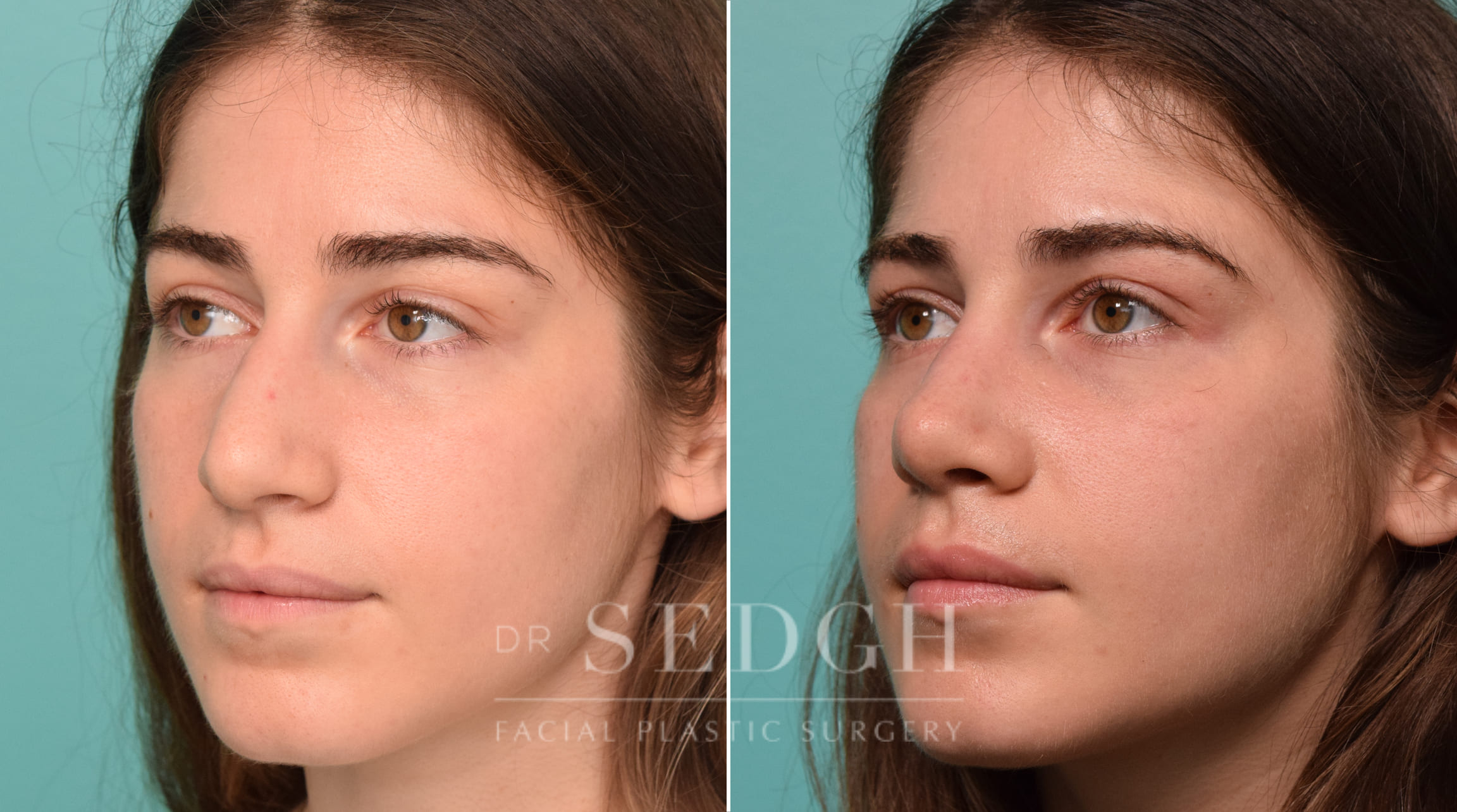
This case is a great example of how much the nasal tip influences overall facial aesthetics. By refining the tip definition, rotation, and projection, we were able to create a more balanced and elegant result while keeping the nose natural and harmonious with the rest of the face.
Tip Revision Rhinoplasty Cost in Los Angeles
The cost of tip revision rhinoplasty varies depending on several factors.
According to the ASPS, the average surgeon fee in 2023 for rhinoplasty was $7,637. However, fees from experienced specialists in Los Angeles can be significantly higher, from $15,000 to $20,000, and can even go up to $30,000 to $40,000.
Associated cost include:
- • Anesthesia costs
- • Operating facility fees
- • Post-operative care and follow-up
Since tip revision rhinoplasty is a lot more work, final price is usually higher. There is no fixed rhinoplasty cost, Los Angeles patients often see higher prices because the city has such high standards for facilities and very experienced surgeons.
How to Choose the Best Revision Rhinoplasty Surgeon in Los Angeles
Things to consider when choosing a revision rhinoplasty surgeon:
| Board certification by ABFPRS or ABPS | A doctor who has board certification either from the ABFPRS or ABPS. This confirms a surgeon’s specialized capabilities. | |
| Proven experience with revision rhinoplasty | Revision procedures are more complex than primary surgery. Surgeons who do a lot of revision rhinoplasty and tip revision are better equipped to handle scar tissue and any changes from previous surgery. | |
| Extensive before and after photo gallery | A strong gallery allows patients to review real surgical outcomes and evaluate how the surgeon performs nasal tip refinement and other revision procedures. | |
| Verified patient reviews | Reading patient reviews gives a better feel for how surgeons communicate and provide information on the healing process. | |
| Hospital privileges | Hospital privileges mean a hospital has reviewed the surgeon’s qualifications and approved them to perform surgical procedures. | |
| Transparent consultation process | A thorough consultation must be clear about the plan and the risks. Surgeons must be open about the results and the rhinoplasty recovery time so patients know what to expect. |
Experienced and board-certified facial plastic surgeons provide safe surgical plans, a reflection of their expertise and the patient’s goals.
Before and After Results: What Realistic Outcomes Look Like
A good tip revision rhinoplasty is more about making small, smart fixes than changing your whole face.
Patients typically see improvements such as:
- • A more defined nasal tip
- • Balanced facial proportions
- • Improved nasal symmetry
- • Natural results that preserve ethnic features
Modern ethnic rhinoplasty is all about making the nose look better without losing cultural identity. A result that looks natural, that is the end-game.
Non-Surgical Alternatives to Tip Revision
It is quite common for people to look at other options before they decide to go back under the knife. A non-surgical nose job uses dermal fillers to hide small mistakes or uneven spots.
These treatments can help:
- • Hiding tiny bumps
- • Improve symmetry and help the nose look more even from the front
- • Enhance tip projection slightly
However, fillers have limitations. They cannot fix a nose that has collapsed or one that has major structural problems. They also will not help if you have trouble breathing. These results are not permanent and usually fade away after 6 to 18 months.
Risks and Complications
Every surgery has its downsides and you should know what they are. While a tip revision rhinoplasty is a common fix there are still things that can go wrong.
Some patients might face an infection or find that the nose still has an uneven look after it heals. The thing is that scar tissue could return or breathing might become more difficult. It is worth noting that these risks are much lower when patients pick an expert surgeon and follow all recovery steps.
Frequently Asked Questions
Most surgeons recommend waiting at least 12 months after the first operation.
Yes. It is more complex because of things like scar tissue and changes to the natural anatomy.
Swelling goes down in a few weeks, but the final look can take a full year.
Fillers might hide small bumps, but they cannot fix underlying structural problems.
Consult a surgeon and be evaluated if there is a need for either a full revision or tip-only.
Schedule a consultation with our board-certified Los Angeles facial plastic surgeon and explore natural-looking tip refinement revision rhinoplasty.
Posted on behalf of Sedgh Plastic Surgery